
The summer holidays are coming in Australia, and the Christmas break in the UK and the US. More free time, maybe a new console or a gift card, and a group of friends who log on every night for one more match. For a lot of kids, Roblox, Fortnite or Minecraft aren't just games: they're where they hang out with their mates.
This guide is for parents and carers who want to understand that world without panicking: what's good about it, what the in-game chats can bring, and how to stay involved without fighting over every minute of screen time.
In short:
Playing online is mostly a way of being with other people: you build a team, you lose, you try again. For quieter kids, it's sometimes the easiest way to belong to a group.
The signals Xoul detects in WhatsApp conversations about games point the same way. In August and September 2026, in families using Xoul, 95 in 100 gaming-related signals were positive or neutral. Around 3 in 10 were about playing with friends: organising a match, inviting someone or planning to play together at the weekend. And for every conflict signal about a game, there were about 10 about group life.

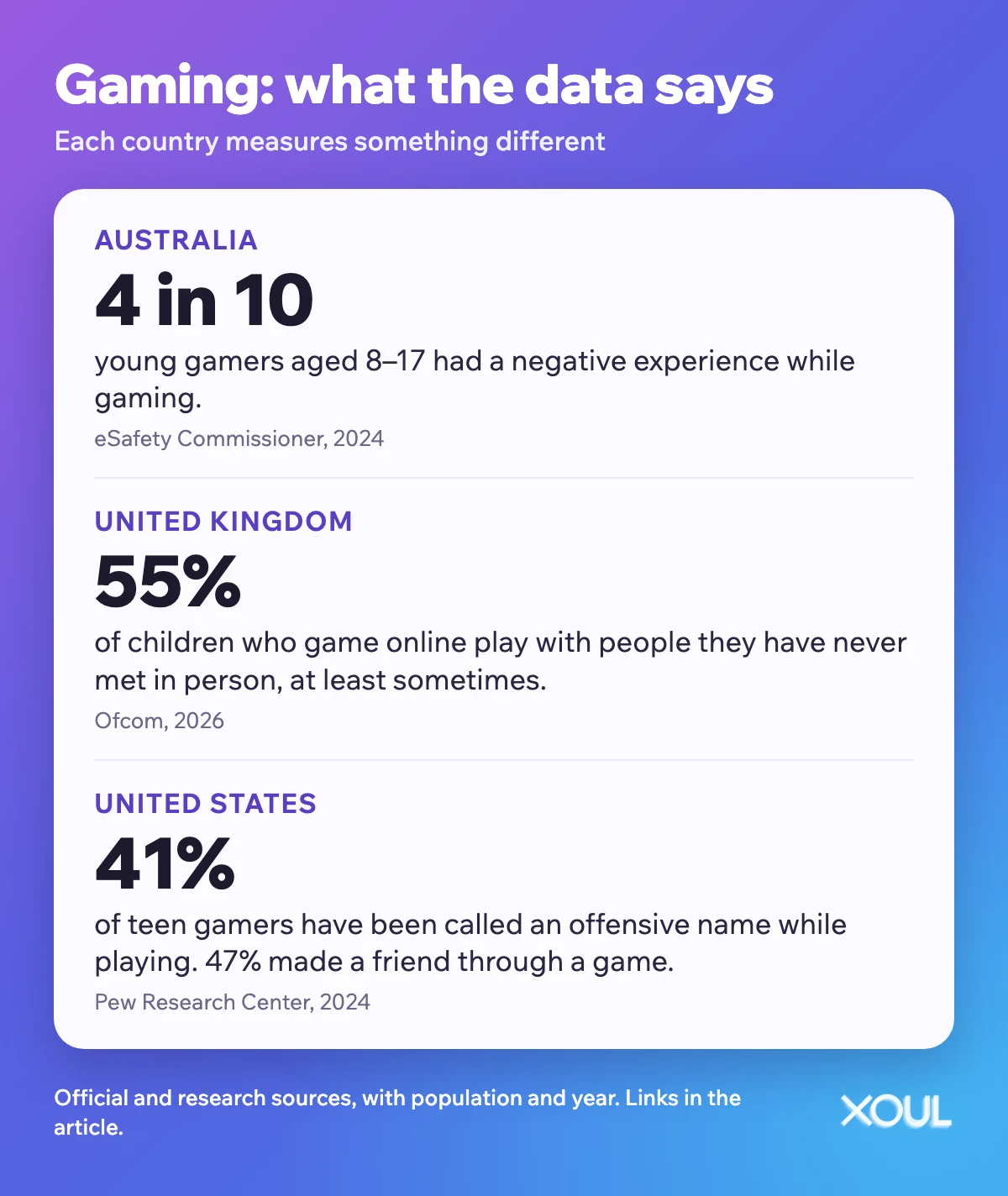
Each survey measures different things at different ages, so it's best to read each figure on its own rather than compare countries:
The calendar shows. In the signals Xoul detects, gaming takes up more space when school is out. In families using Xoul, gaming went from 1.8 in every 100 signals in May to 2.6 in August, and dropped back to 2.1 when school started again.
That's a share, not a total: it shows how much room games take up in their conversations. Before the long summer break, it's a good time to look at the settings together.

In families using Xoul, Roblox is the game named most often in these signals, especially at ages 10 to 12, followed by Fortnite and Minecraft.

Kids rarely come out and say something in a game is bothering them. What you usually notice first is a change:
No single sign means something is wrong. If several show up together, it's worth a calm chat.
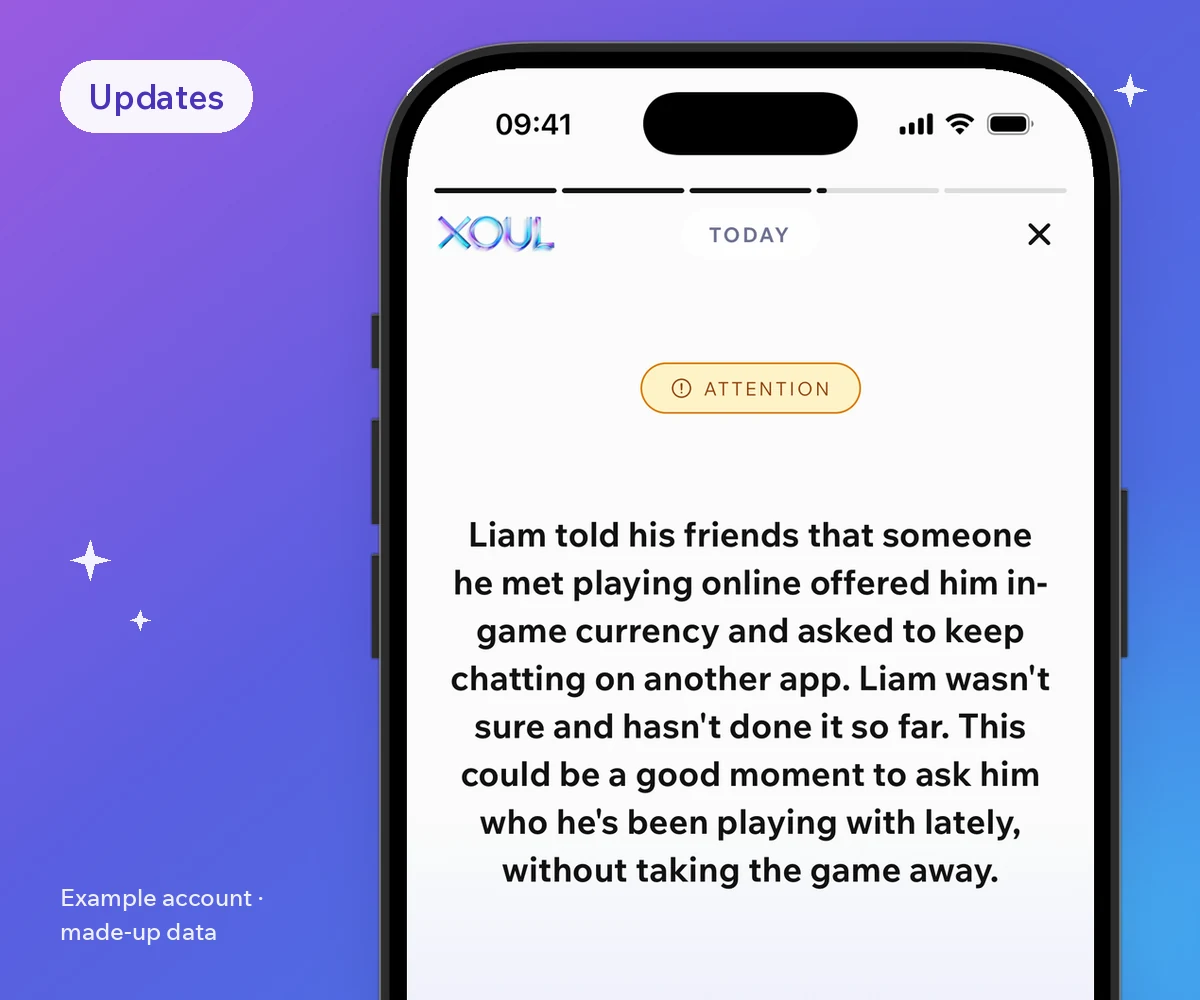
This is how an Update looks in the app. An example account with made-up data.
Xoul can't see what happens inside Roblox, Fortnite or Discord. But if a contact from a game asks to move to WhatsApp, or your child tells their group about something that made them uncomfortable in a match, it can show up in the report or in Updates, with an "Attention" label when it needs care.
It works best when you do it together and explain what each setting is for. Five things to check:

A sudden ban usually creates more tension than agreement. In the family-related signals Xoul detects, when a game comes up, about 1 in 5 is a tension: a ban on playing as punishment, a surprise rule, an argument about game time.
It works better to agree ahead of time, together: times that protect sleep, a few minutes' warning before stopping (you can't always pause a match), where in the house they play and what happens if an agreement is broken. If you'd like to write it down, here's how to create family technology agreements.

The best conversation about gaming starts with curiosity, not suspicion. A few ideas:
If you use Xoul, the conversation idea in each report can be a good way in.
A general summary (not legal advice):
If you suspect grooming, don't delete the conversation or confront the person: screenshot the profile and messages, report the account to the game, and report it to the authorities (see above).
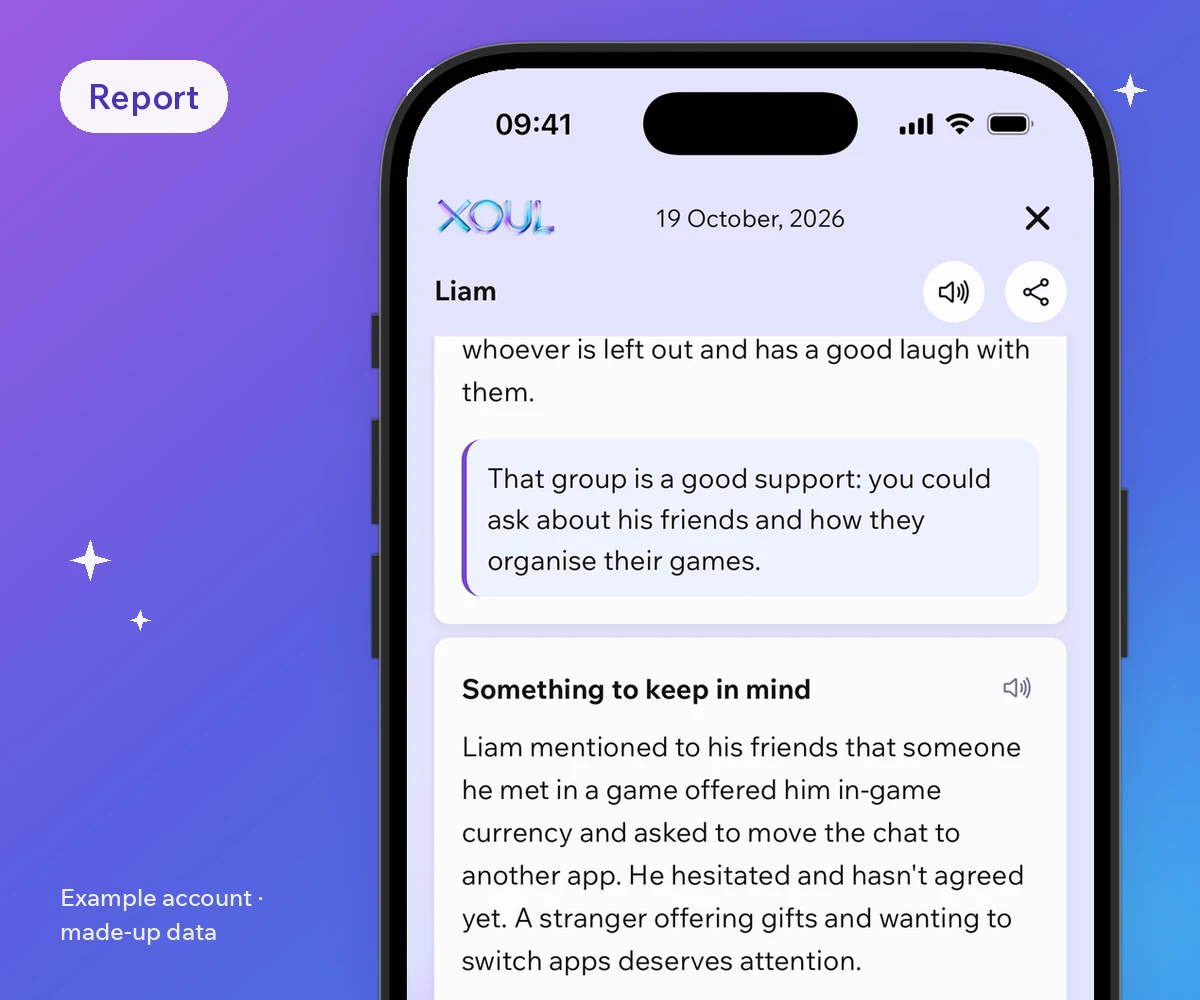
This is how a report looks: what was noticed and an idea for a conversation. An example account with made-up data.
Xoul connects to your child's WhatsApp with a QR code, always with their consent. AI, overseen by a clinical team, shows you how they're doing in regular reports: their mood, friendships, what's on their mind and an idea for a conversation. Trends shows how things change over time.
It's worth being clear about what it doesn't do: Xoul can't see chats inside games or on Discord, and it doesn't analyse images. What can show up is what happens, or what they talk about, on WhatsApp: match plans with their group, a falling-out after playing, or a contact from a game who wants to keep chatting there. You never see their messages, which are deleted after the system analyses them.
It depends on the game and on your child. Check the age rating and each platform's minimum age, such as Discord's 13. Before then, it's best with chat off or limited to friends they know.
You don't need to. Reading in secret can break trust. It's better to set up together who can talk to them and agree they'll tell you if something feels off. With Xoul you can see how they're doing without reading their messages, and always with their consent.
In most places they aren't legally treated as gambling, but they're similar: you pay without knowing what you'll get. That's why spending limits and a chat about how they work help.
No. Xoul can't see those apps. If that contact moves to WhatsApp, or your child mentions it to their group, it can show up in the report or in Updates; it isn't an instant alert. It doesn't replace the conversation, but it helps you know when to have it.
Games aren't the enemy: they're part of how kids make friends and have fun. What protects them most is an adult who asks with curiosity and is there if something goes wrong.
Your first Xoul report is free, arrives in 10 minutes and doesn't need a card. Download Xoul and start today.
XOUL gives you private reports with risks, emotions and important moments, always from a respectful approach.