
They laugh at their phone at the dinner table. They game every night with "a mate from Brisbane" they've never met. They talk about someone from their Minecraft server as if they were in the same class. If that sounds familiar, it isn't a problem. It's simply how friendships work today.
In short:
Yes. For many young people, online games, social media and group chats are just another place to hang out and to find people who share their interests. At this age, belonging and feeling understood matter a lot, and school doesn't always offer that. Most of these friendships are with kids their own age and stay online.
Research from several countries points the same way:
| Country | What the data says | Source |
|---|---|---|
| Australia | 55% of 8- to 17-year-olds have been in contact with someone they first met online (69% of 14- to 17-year-olds). Almost half of them said that person was a contact of a friend or family member. | eSafety Commissioner, Mind the Gap (3,590 children, surveyed in 2021) |
| UK | 31% of 8- to 17-year-olds who game online say they chat with strangers while gaming; 64% chat with friends or people they know in real life. | Ofcom, Children's Media Literacy Report 2024 |
| US | 57% of teens aged 13 to 17 have made at least one new friend online; 20% of all teens have met an online friend in person. | Pew Research Center, 2015 |
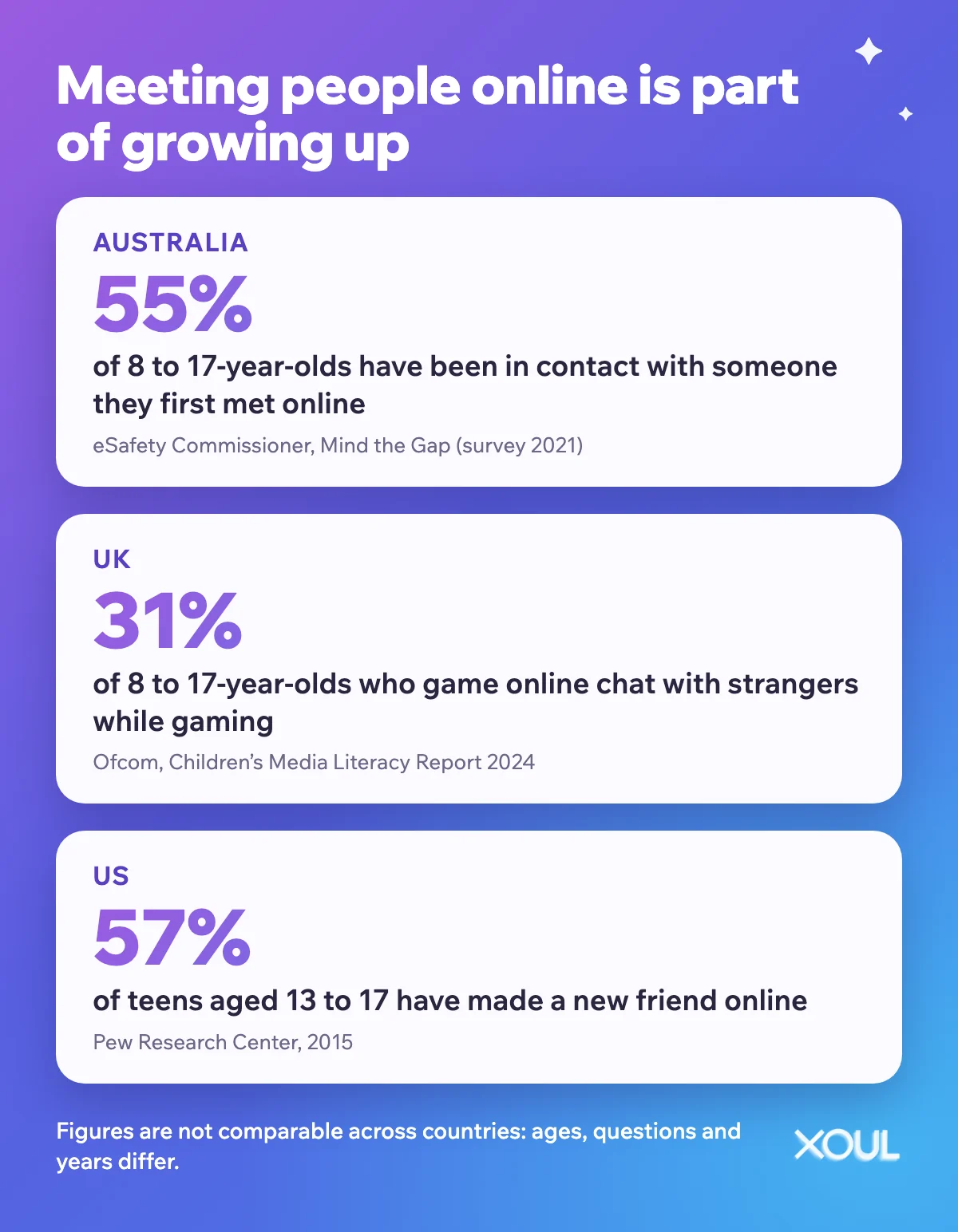
The figures can't be compared directly (the ages, questions and years differ, and the US survey dates from 2015), but they tell the same story: meeting people online is part of growing up. In Australia, 12% of children had met someone face to face in the past year after first getting to know them online, rising to 19% among 14- to 17-year-olds. In other words, most online friendships stay online.
A healthy online friendship looks like any good friendship. It's with someone of a similar age, it feels balanced, and your child comes away from those chats feeling the same or better. There are no forced secrets and no rush, and your child can talk to you about that person without it feeling awkward.

Some signs it's going well:
Pay closer attention when the friendship involves secrecy, rushing or pressure: someone who asks your child not to tell anyone, wants to move straight to a private chat, sends gifts or makes promises, or asks for photos or personal details. No single sign proves anything, but together they're worth a conversation.
The most common signs:
Spotting one of these doesn't mean something bad is happening. It's simply a good reason to check in. To find out more, read our guide on what grooming is and how to spot it.
If you use Xoul: friendships that start in a game or an app often carry on over WhatsApp. There, things worth a closer look (someone pushing for secrecy, pressure to always reply, or a change in mood after those chats) may show up in the report or in Updates. You don't see their messages: you see how they're doing and what might be worth talking about. Xoul analyses WhatsApp text and voice notes, not images, and it can't see what happens in other apps.
In the signals Xoul picks up in families who use it, the most common reaction to an unknown contact is asking who they are: about 1 in 4 signals of contact with strangers. Overall, 85% of signals of contact with strangers are positive or neutral. Many young people already know how to set limits; parents and carers can back that up.

Another reassuring finding: 1 in 3 limit-setting signals Xoul picks up is a clear "no". Most of those are said to friends or family, not strangers, but it's the same skill they need when someone online keeps pushing. When you notice your child has said no to something they didn't like, let them know you noticed. That's how they learn to use it when it really matters.
Signals detected by Xoul in WhatsApp conversations of families using Xoul, August–September 2026. n = 617 signals of contact with strangers and 37,125 limit-setting signals. Approximate values.
Start with curiosity, not a warning: ask what they play, who with and what they like about that person. If your first reaction is to ban it or take their phone, they learn not to tell you. What you want is for them to come to you when something feels off.
Some ideas that help:
If a first phone is on the horizon, our guide on how to prepare as a family covers that conversation and the agreements that go with it.
With Xoul, each report describes how your child gets on with others. It includes a suggestion for supporting their friendships and an idea for a conversation based on what they're going through. That helps you bring up the topic at the right moment, without asking to see their messages.

Get help if someone has asked for intimate photos or money, is threatening to share something, an adult keeps pushing to meet alone, or your child is very distressed. Don't delete the messages: take screenshots, block the account and report it on the platform.
If sadness or anxiety lasts for weeks, also talk to your GP, paediatrician or a mental health professional.
There's no set age. It often starts with online games before 12 and becomes more common in the teenage years. More than age, what matters is who they talk to, how much they share and whether they know which details to keep private.
A total ban often pushes it underground. Agreeing on clear rules works better (what not to share, no secrets with adults, tell you if they want to meet someone), along with reviewing their privacy settings together.
You can't always tell. Some clues: they avoid video calls, their story changes, they're much older or they ask for secrecy. If in doubt, your child shouldn't share personal details and should talk it over with you.
No. With your child's consent, Xoul analyses their WhatsApp conversations (text and voice notes) and turns them into reports and Updates. You never see their messages: you see how your child is doing. Information is encrypted when it's sent and when it's stored.
Online friendships are a real part of your child's life. Supporting them with curiosity rather than suspicion makes it more likely they'll tell you if something changes. Find out more about how Xoul works: your first report is free. Download Xoul.
Updated 19 October 2026.
XOUL gives you private reports with risks, emotions and important moments, always from a respectful approach.