
In just a few years, the question of when children should be on social media has moved from the kitchen table to parliament. Australia now keeps under-16s off the biggest platforms, the UK is preparing its own ban for 2027 on top of the Online Safety Act, and in the US, COPPA protects children's personal data.
This guide brings together, country by country, what applies today and what is coming, with the official source for each law. It is for information only and is not legal advice. Updated 19 October 2026 · Next review: quarterly (January 2027).
In this guide:
Each of these countries protects children online in a different way: Australia sets a minimum age for social media, the UK puts safety duties on platforms and is moving towards a minimum age, and the US focuses on children's personal data. This table sums up the position as at 19 October 2026.
| Country | What applies today | What is coming | Status on 19 Oct 2026 |
|---|---|---|---|
| Australia | Social media minimum age of 16 for age-restricted platforms (Online Safety Act) | eSafety reviews which platforms are covered | In force since 10 Dec 2025 |
| United Kingdom | Online Safety Act: children's safety duties, Ofcom codes in force since 25 Jul 2025. Age 13 to consent to data use (UK GDPR) | Under-16 social media ban; no livestreaming or stranger contact for under-16s | Ban announced; regulations due before Christmas, expected spring 2027 |
| United States | COPPA: verifiable parental consent for children under 13; rule updated in 2025 | State laws vary | In force (federal) |
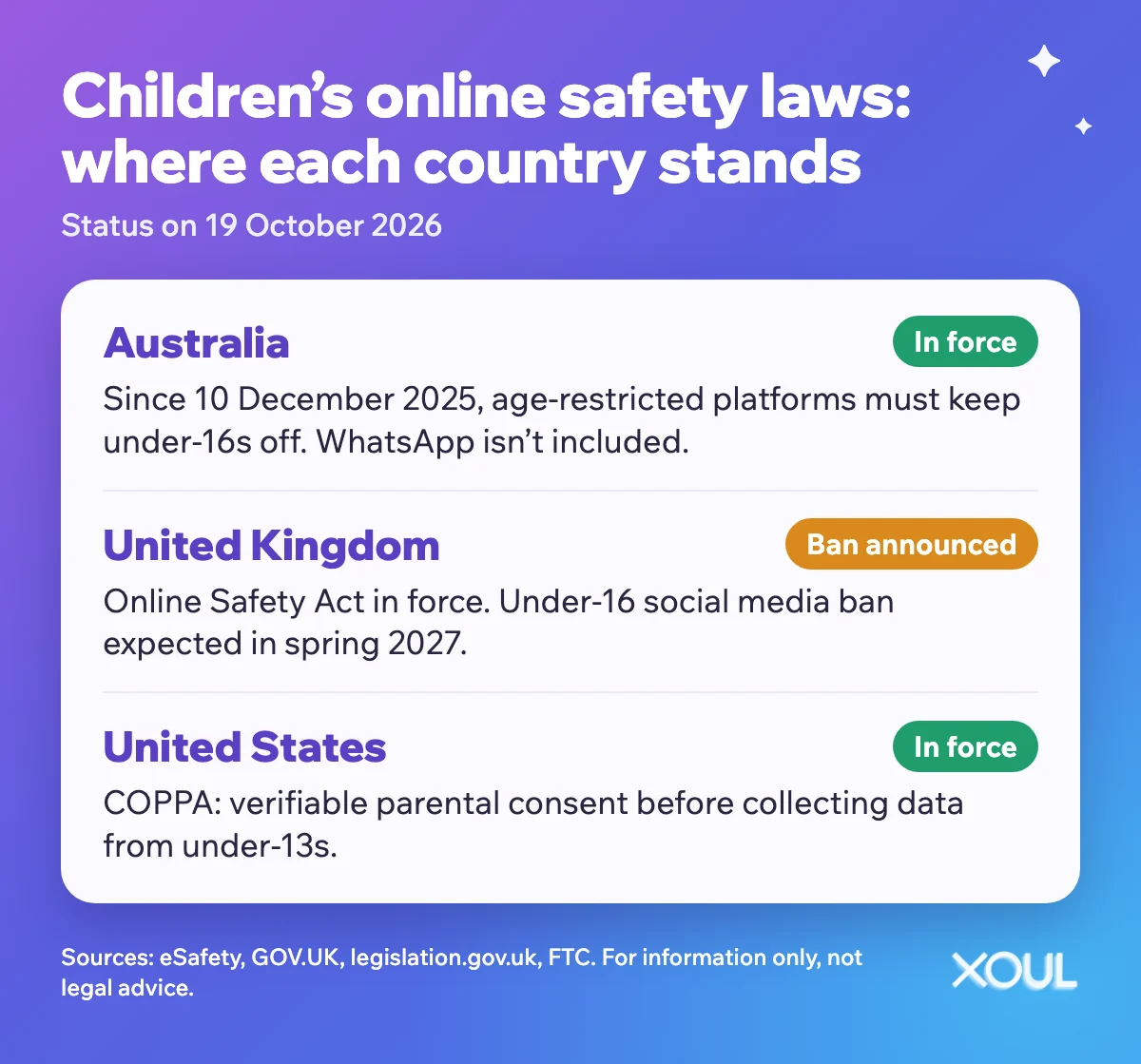
Since 10 December 2025, platforms that eSafety lists as age-restricted, including Facebook, Instagram, Snapchat, TikTok, X and YouTube, must take reasonable steps to stop under-16s from having accounts. The responsibility sits with the platforms, not with children or parents. Messaging apps such as WhatsApp are not included.
Who is covered. According to eSafety, the age-restricted platforms are Facebook, Instagram, Kick, Reddit, Snapchat, Threads, TikTok, Twitch, X and YouTube.
Who is not. Services whose main purpose is messaging or calls are excluded. eSafety lists WhatsApp, Messenger, Discord, Roblox and YouTube Kids among the services that are not age-restricted, and in March 2026 it confirmed that an update to the rules did not change that.
What it means at home. Many under-16s will spend more of their online social life in messaging apps. eSafety's early evaluation found that daily use of messaging platforms among 10- to 15-year-olds rose from 40.5% to 52.3% after the law came in.
Official source: eSafety Commissioner · Verified 19 Oct 2026 · Next review: quarterly.
The Online Safety Act already requires online services to protect children from harmful content, and Ofcom's children's codes have applied since 25 July 2025. On 15 June 2026 the government announced an under-16 social media ban, expected to take effect in spring 2027. Messaging services such as WhatsApp are not intended to be covered.
What applies now. Under the Online Safety Act, user-to-user services have to assess whether children use them and protect them, and the government says platforms must make sure strangers have no way of messaging children. Separately, under the UK GDPR and the Data Protection Act 2018, from the age of 13, children can consent to an online service using their data.
What is coming. According to the government announcement:
We look at what this means for messaging in WhatsApp after the UK social media ban.
Official source: GOV.UK and legislation.gov.uk · Verified 19 Oct 2026 · Next review: quarterly.
COPPA, the Children's Online Privacy Protection Act, protects children under 13. Services aimed at children, and services that know they are collecting data from a child under 13, must get verifiable parental consent first. Parents can review their child's data, have it deleted and stop further collection.
What it requires. According to the FTC's COPPA guidance, operators must get consent before collecting personal information from a child, with limited exceptions, using methods such as a signed form, a card transaction or a government ID check.
Parents' rights. You can ask to see your child's personal information, have it deleted and stop the service from collecting more.
What changed. The FTC updated the COPPA Rule in April 2025 (16 CFR Part 312). COPPA does not set a minimum age for social media; most platforms set their own at 13. Several states have their own rules, which this guide does not cover.
Official source: Federal Trade Commission and eCFR · Verified 19 Oct 2026 · Next review: quarterly.
WhatsApp's minimum age is 13 in most countries. It is not on Australia's list of age-restricted platforms, and the UK government has said messaging services such as WhatsApp are not intended to be covered by its ban. In the US, COPPA applies to under-13s across online services.

For under-13s, WhatsApp offers parent-managed accounts, where a parent chooses who can message their child and which groups they join, without reading their messages. These accounts do not support linked devices, so Xoul cannot connect to them. For 13- to 17-year-olds, there are optional parental controls that parent and teen both have to accept. Both tools are rolling out gradually and may not be available in your country yet, according to WhatsApp's Help Center.
Our teen digital safety guide covers the settings worth reviewing together.
Laws put duties on platforms, but they don't talk to your child. What protects them most still happens at home: talking often, agreeing rules together, setting up privacy as a team and being there when something feels off, without punishing them for telling you.

These laws recognise that children gain independence as they grow: in the UK, for example, a 13-year-old can consent to how an online service uses their data. Whatever the rules say, supporting your child with their agreement protects something no law can require: trust.
Monitoring in secret can feel like being in control, but when a child finds out, it breaks the very channel you need most if something goes wrong. That's why, at Xoul, your child's consent isn't a detail: it's the condition for getting started. Our guide on how to talk to your child about Xoul suggests how to open that conversation.
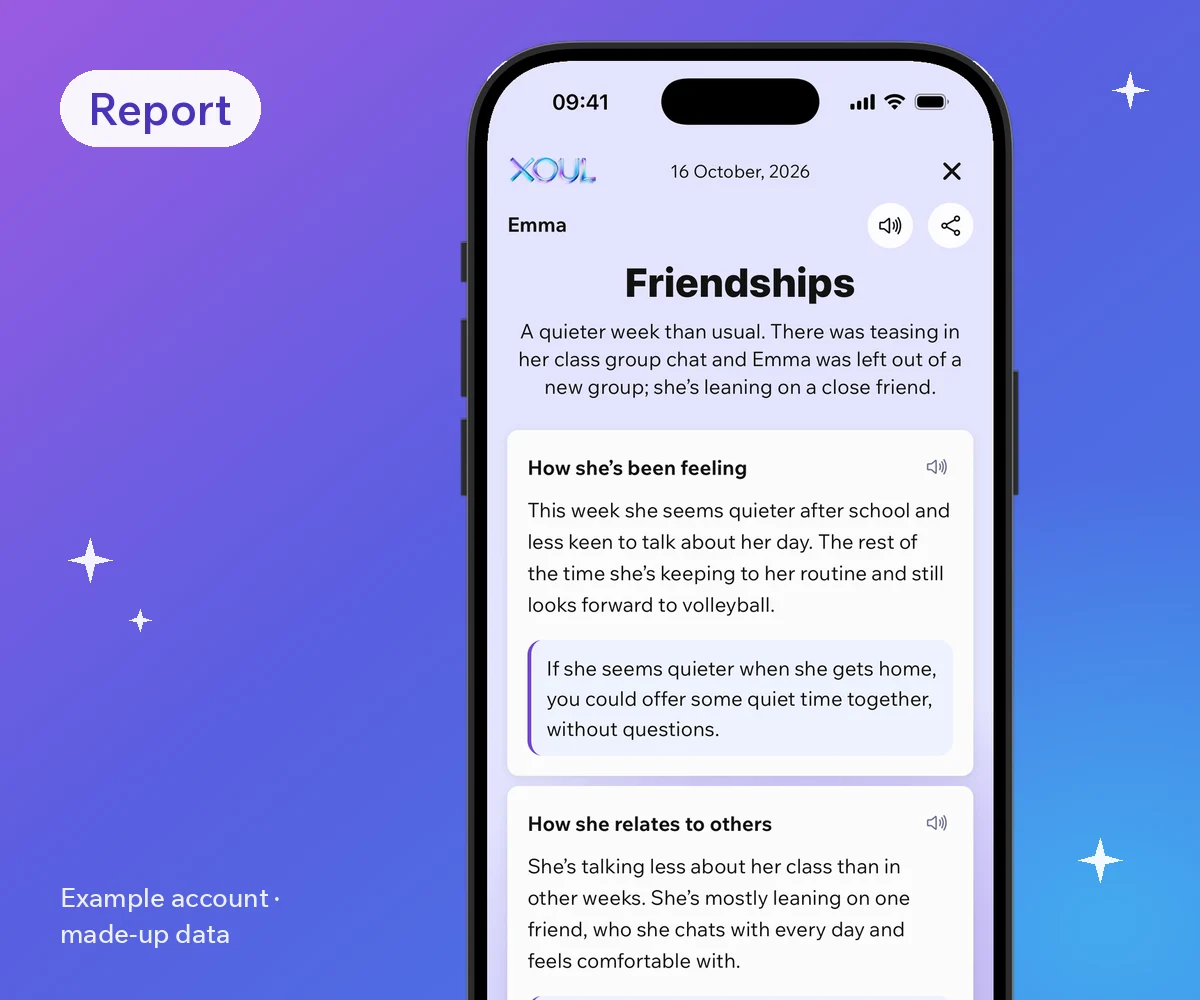
Supporting without spying means knowing how your child is doing without reading their conversations. That is what Xoul does: it doesn't show you their messages; it shows you how they're doing, through emotional wellbeing reports, Updates and a chat to help you think through what to do.
Download Xoul and get your first report free
No. The social media minimum age applies to the platforms eSafety lists as age-restricted, such as Instagram, TikTok and Snapchat. eSafety lists WhatsApp among the services that are not age-restricted, because its main purpose is messaging.
The government expects it to take effect in spring 2027. It plans to bring the regulations to Parliament before Christmas 2026, under the Children's Wellbeing and Schools Act. Until then, the Online Safety Act's existing protections apply.
No. COPPA protects the personal data of children under 13 and requires verifiable parental consent. It does not set a minimum age for social media, although most platforms set their own minimum at 13.
It depends on where you live and on your circumstances, and this guide is not legal advice. Beyond the law, reading their messages in secret tends to damage trust. An alternative is to support them with their consent, without seeing their conversations.
We review it every three months and whenever one of these countries makes a significant change. You'll find the date of the latest check at the top of the guide and at the end of each country section.
All verified on 19 October 2026. Next review: quarterly.
This article is for information only and is not legal advice. For advice about a specific situation, speak to a legal professional where you live.
XOUL gives you private reports with risks, emotions and important moments, always from a respectful approach.