
For most kids, WhatsApp isn't "just another app". It's the class group chat, the weekend plans, the voice notes with their best friend and the family chat. In many ways, it's their social life. So when your child asks for WhatsApp, the real question isn't only "what age?" but "how do I support them?".
And it's growing. In the US, about a quarter of teens aged 13 to 17 (24%) now use WhatsApp, up from 17% in 2022, according to Pew Research Center.
This guide brings together what families need to know, in order: what to decide first, what to set up together, what goes on in group chats, what to do if a stranger gets in touch, and how to stay close without reading their messages. Updated 19 October 2026.
In this guide:
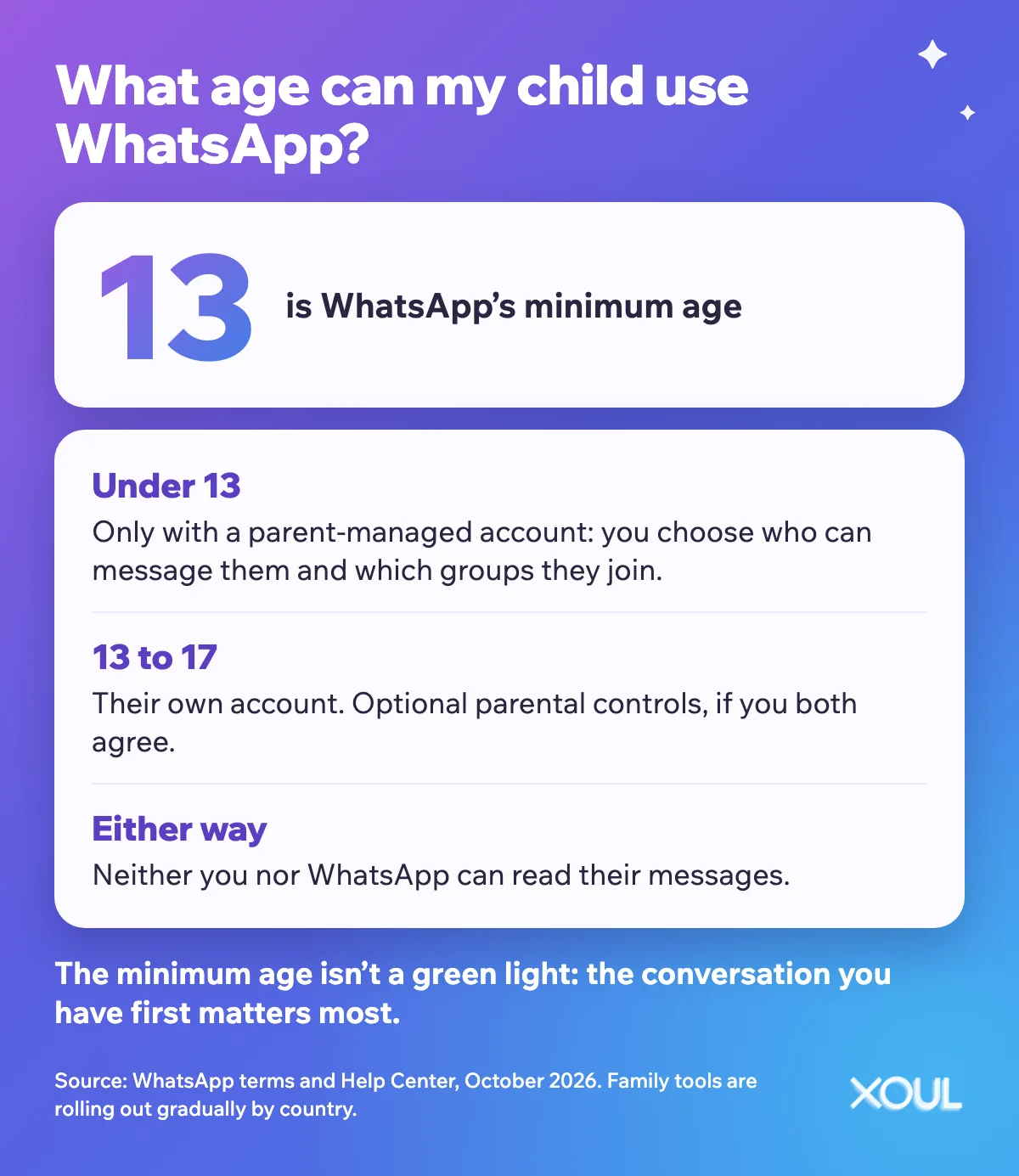
Under WhatsApp's terms, you need to be at least 13, or older if the law in your country requires it. Below that age, the only option is a parent-managed account.
What the law says is a separate question from what the app allows:
| Country | WhatsApp minimum age | Worth knowing |
|---|---|---|
| Australia | 13 | The under-16 social media minimum age, in force since 10 December 2025, does not cover WhatsApp: eSafety lists it among services that aren't age-restricted, because its main purpose is messaging and calls. |
| United Kingdom | 13 | Under UK GDPR, children can consent to online services themselves from 13. The Online Safety Act doesn't set a minimum age, but requires platforms to protect children, including from strangers contacting them. |
| United States | 13 | Most apps set 13 as their minimum because of COPPA, the children's online privacy law. |
General information as of October 2026; not legal advice.
That said, just because the app allows it doesn't mean your child is ready. The minimum age isn't a green light. Some 13-year-olds still don't know what to do if they're added to a group full of strangers, and some 12-year-olds handle it really well. What matters most is the conversation beforehand, and knowing they can come to you.
They're ready when they can stick to a few basic agreements and know who to turn to if something feels off. Age matters less than whether they understand that what they write or forward can travel, that not everyone is who they say they are, and that telling you about something bad won't cost them their phone.
A few questions to think through as a family:
Once you've talked it through, write your agreements down and review them every few months. There are ideas in how to create family technology agreements and getting ready for a first phone.
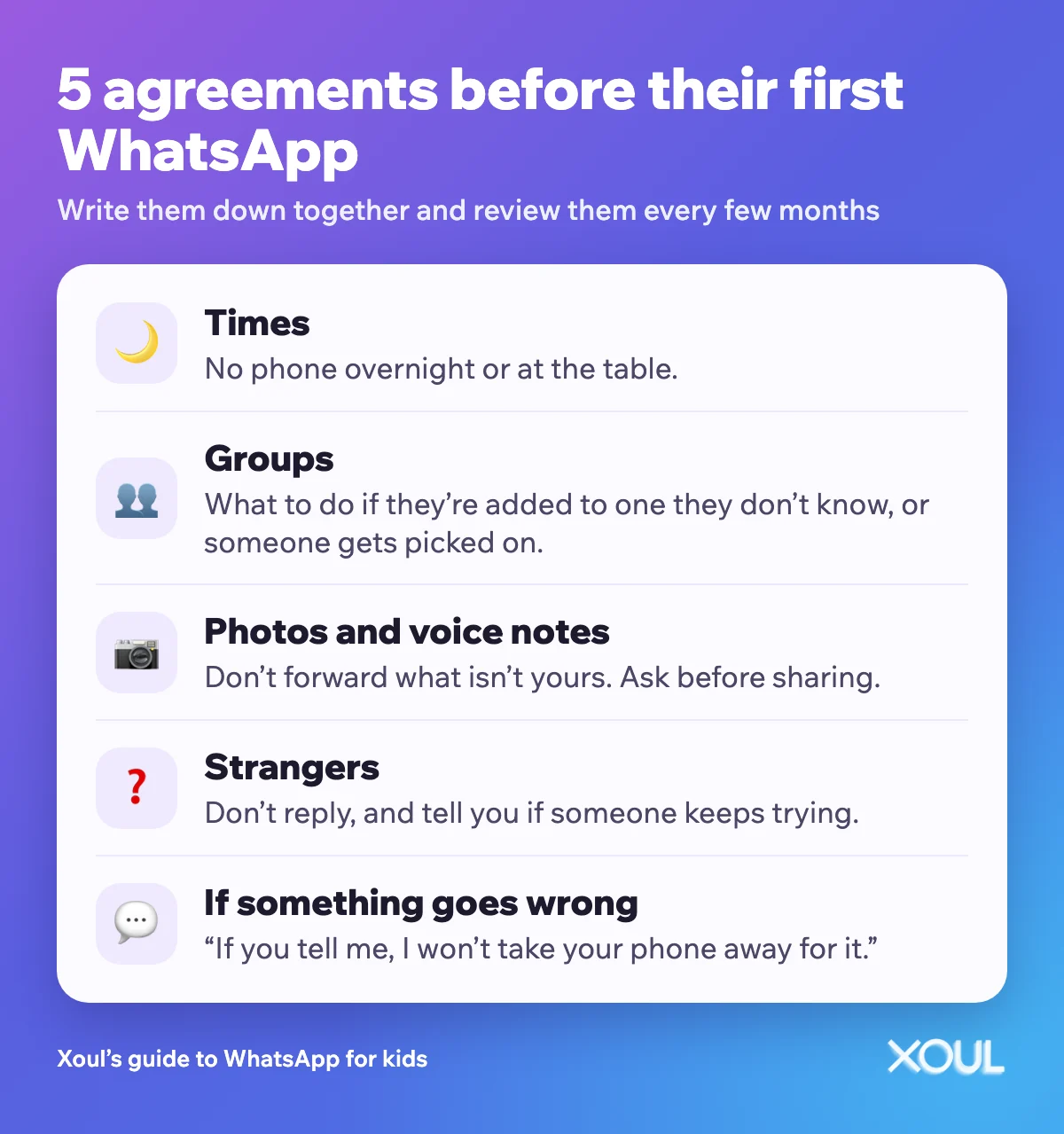
A good WhatsApp agreement usually covers:
If you're planning to use Xoul, this is a good moment to talk about it: your child's consent is required, and explaining what you'll see and what you won't is part of the agreement. Here's a guide for that: how to talk to your child about Xoul.
The key ones are in Settings > Privacy: who can add them to groups, who sees their profile photo, About and last seen, who sees their Status, and silencing calls from unknown numbers. Set them up together and explain what each one is for, so they understand them and don't see them as a punishment.

Step by step:
WhatsApp also has a Privacy Checkup (in Settings > Privacy) that walks you through these settings one by one. Doing it together takes five minutes and is a good excuse to talk about why each one matters.
Almost everything: homework, memes, plans and the odd falling-out. Most of the friction is everyday conflict that sorts itself out. But the group chat can also be where someone gets left out or where the teasing starts, with the whole year group watching. That's why it's worth asking about the group, not just about school.
The first thing to know is that most falling-outs aren't bullying. In August and September 2026, for every bullying signal, Xoul picked up 63 signals of everyday peer conflict: arguments, misunderstandings and day-to-day disagreements. If every row is treated as a crisis, your child may stop telling you things.
Xoul signals · n = 50,675 everyday-conflict signals and 805 bullying signals · August and September 2026.
What does deserve attention:
If you use Xoul, a situation like this in the group can show up in the report or in Updates, with an idea for a conversation. Xoul doesn't show you the group's messages: it tells you how your child is doing.
A few ideas to help:
To tell everyday conflict from bullying and see what to do step by step, read our full guide to cyberbullying: what it is, how it affects kids and what to do at home.
The best thing they can do is not reply, block and report the number, and tell you. If the person keeps trying, asks for photos or secrets, or suggests moving to another app, it's time to act: keep screenshots, block and, if there are threats or sexual requests, report it. What protects them most is knowing they can tell you.
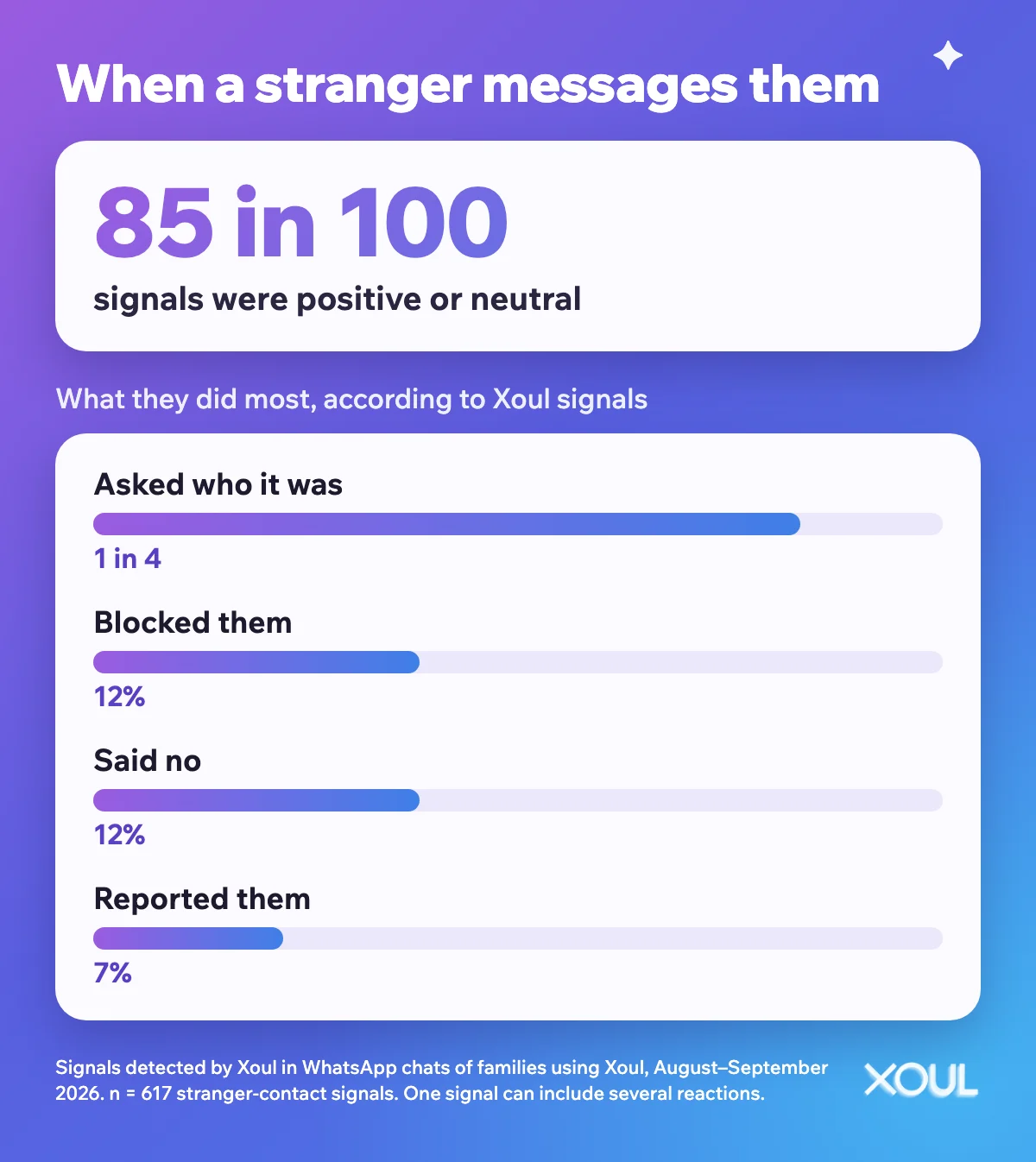
The good news is that many kids already handle it well. Among the signals Xoul picked up in August and September 2026 when someone they didn't know got in touch, 85 in 100 were positive or neutral, and the most common reaction was asking who it was. Setting boundaries comes up a lot in their chats too: 1 in 3 boundary-setting signals is an explicit "no".
Xoul signals · August and September 2026 · n = 617 signals of contact with someone they didn't know and 37,125 boundary-setting signals.
What to do, step by step:
Warning signs of grooming (when an adult builds a child's trust in order to abuse them) often include: lots of attention and compliments, gifts or credit, asking them to keep secrets, asking for photos, and wanting to move to another app or meet up. There's more in what to do if a stranger messages your child and what grooming is and how to spot it.
In 2026, WhatsApp announced two: parent-managed accounts, for under-13s, and parental controls for teens, for 13- to 17-year-olds. Neither lets you read their messages. Both are rolling out gradually, and WhatsApp doesn't publish which countries have them.
| Parent-managed account | Parental controls for teens | |
|---|---|---|
| Who it's for | Under 13 (or under the minimum age in your country) | 13 to 17 |
| Is it required? | Yes: it's the only way for an under-13 to have WhatsApp | No: it's optional and you both have to agree |
| What you decide | Who can message them, which groups they join and their privacy settings | Privacy settings, Status, Channels and Meta AI |
| What you're told about | New, blocked or reported contacts, chat requests and groups | When they join or leave a group, if a group grows a lot, or if they add a contact |
| Can you read their messages? | No | No |
| Announced | March 2026 | September 2026 |
A parent-managed account (under 13) is set up with both phones side by side: on your child's phone you choose "Create a parent-managed account", and from yours you scan a QR code and create a six-digit PIN. By default, only saved contacts can message them; messages from unknown numbers go to a Requests folder for you to approve, and only you can add them to groups. The account has no Status, Channels, Meta AI, location sharing or linked devices (these accounts don't support linked devices, so Xoul can't connect to them), and shows no ads. When they turn 13, it becomes a standard account and the controls end.
Parental controls for teens (13 to 17) are switched on from Settings > Parental controls on their phone, and only if you both agree. If your teen wants to loosen a privacy setting, they need your PIN. It's a good way to agree the settings together rather than impose them. The details are in WhatsApp's Help Center.
These tools control who they talk to and which groups they're in. What they don't tell you is how they're doing: whether they're happy in the group, whether something is worrying them, or whether a friendship is bringing them down. For that, you still need to talk. To see when they're enough and when Xoul adds something, read Xoul vs WhatsApp parental controls.
Staying close means knowing how they're doing without reading what they write. Checking their phone in secret, linking their WhatsApp to another device without them knowing or installing spy apps breaks trust and often leads to secret accounts. What works is a mix of clear agreements, privacy settings and regular conversations.
The options, side by side:
| Option | What it shows you | What it means |
|---|---|---|
| Checking their phone in secret | Their messages | If they find out, they stop telling you things. There are legal and ethical limits |
| Spy apps, or linking their WhatsApp without them knowing | Their messages | It's surveillance. Security and privacy risks for the whole family |
| Phone controls (Family Link, Screen Time) | Screen time, apps and time limits | They don't show what happens inside WhatsApp |
| WhatsApp's own tools (parent-managed account or teen controls) | Who they can talk to, which groups they're in and their settings | They don't tell you how they're doing |
| Xoul, with their consent | How they're doing: mood, friendships, what matters to them and an idea for a conversation | It doesn't show you their messages |
| Talking and making agreements | Whatever they choose to tell you | It's the foundation for everything else |
If you're wondering what the law allows, see is it legal to check your child's WhatsApp?. And if you want to know how they're doing without invading their privacy, read how to know how your child is doing without reading their messages. And for what each way of seeing their WhatsApp actually shows you, read can you see your child's WhatsApp?.
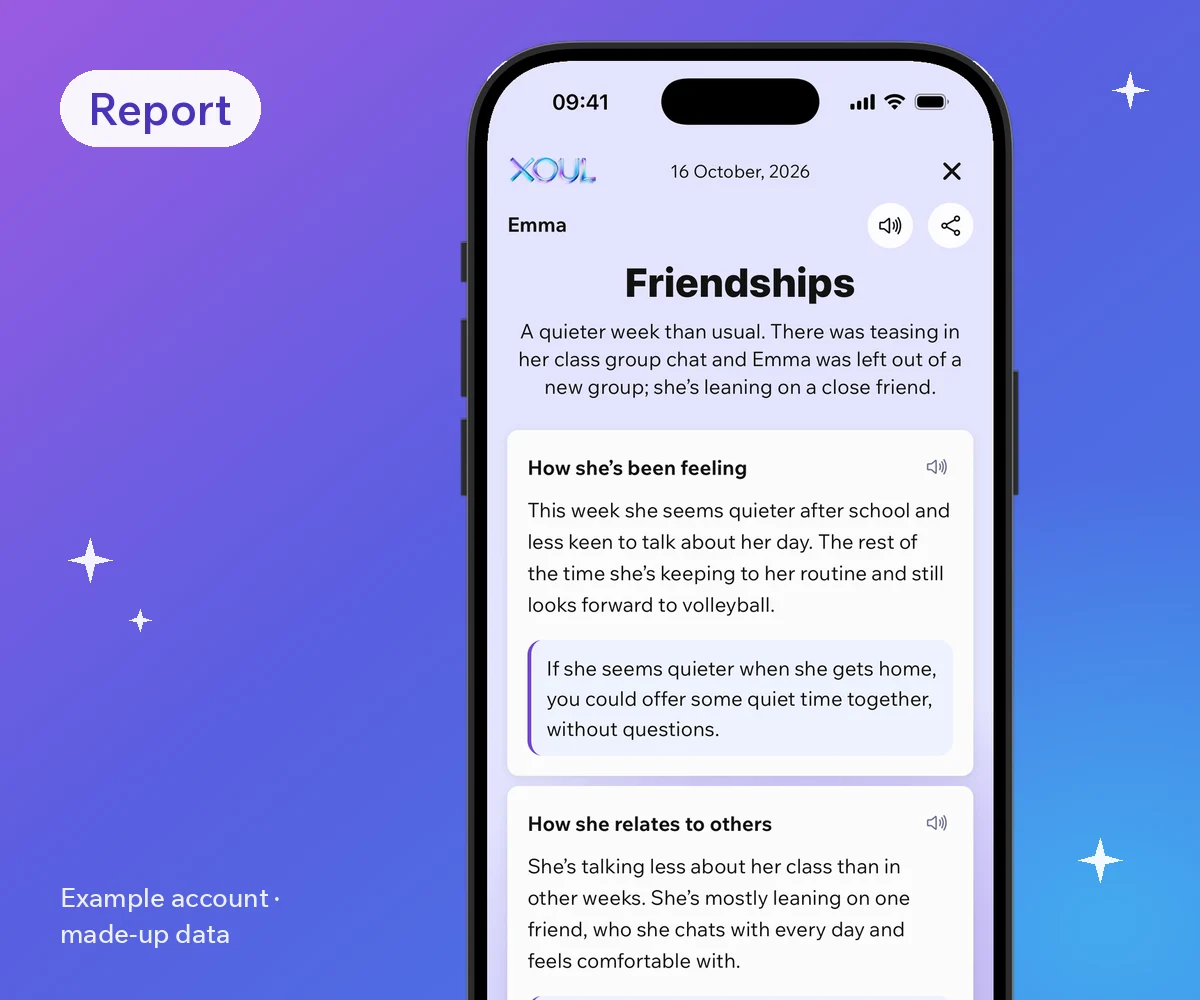
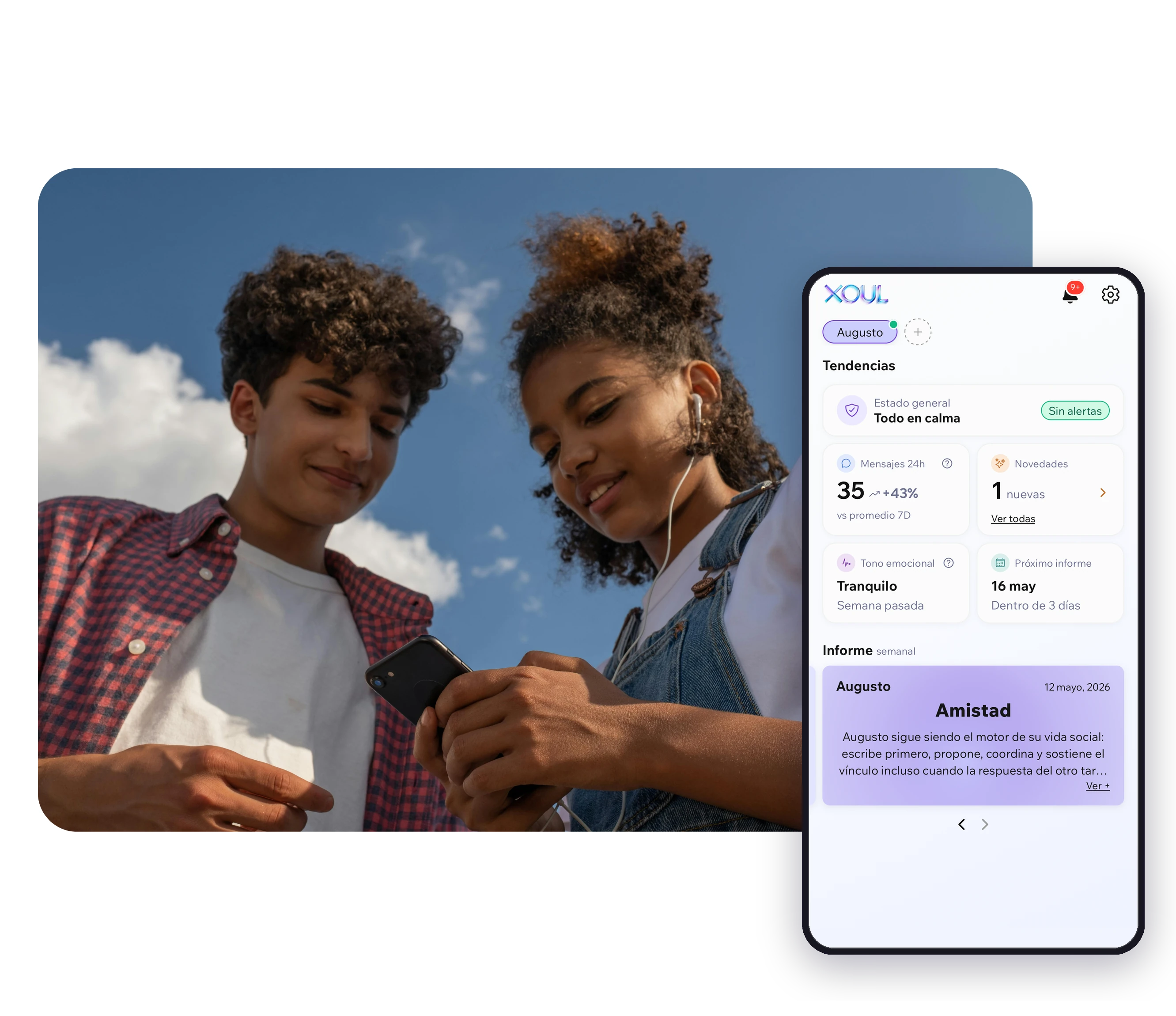
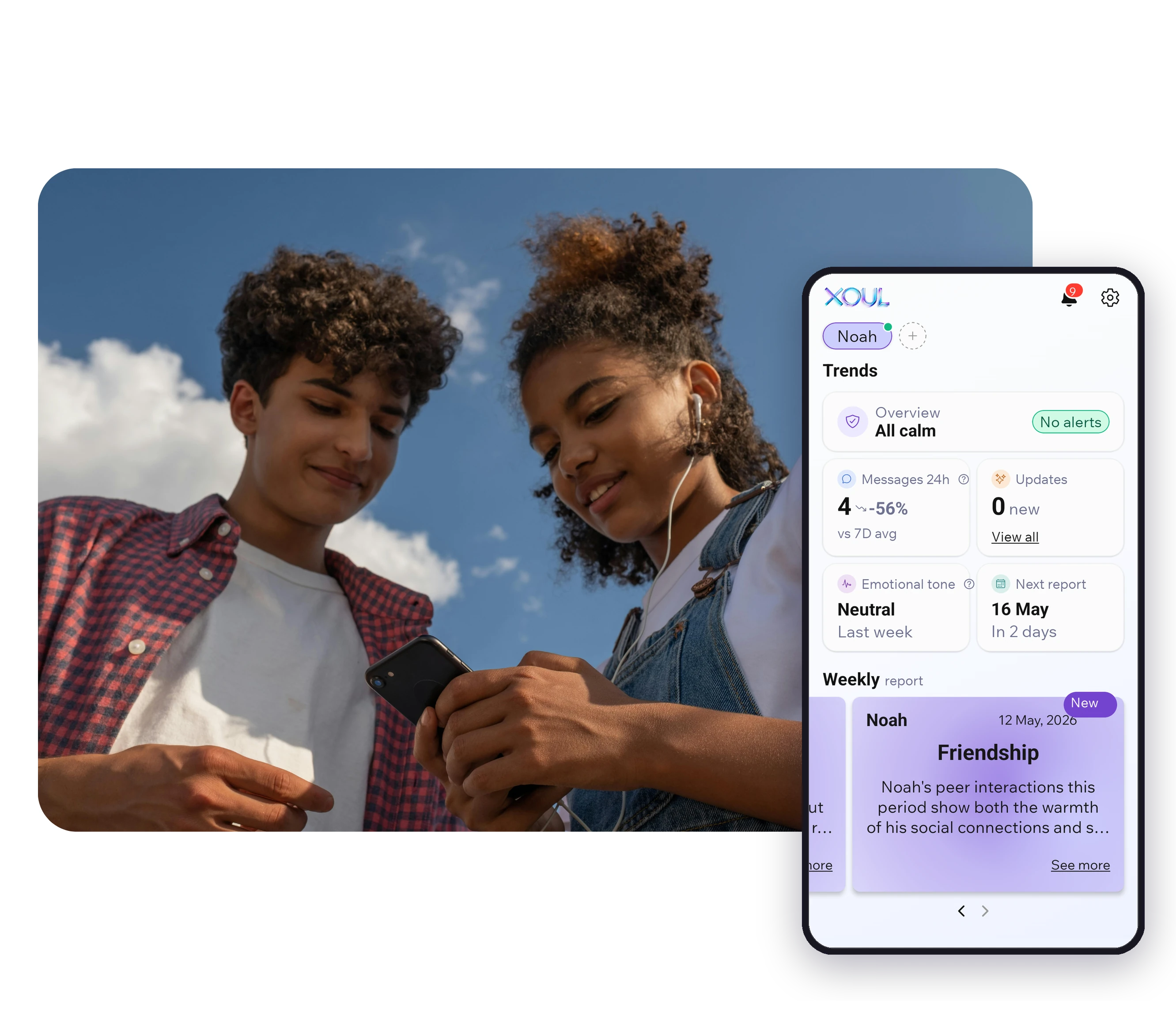
This is what a Xoul report looks like: a summary of the week, how she's been feeling and how she relates to others. Example account with made-up data.
Xoul connects to your child's WhatsApp with a QR code, always with their consent. AI analyses their conversations and tells you how they're doing in regular reports: their mood, friendships, what's on their mind and an idea for a conversation. You never see their messages, which are deleted after the system has analysed them. Xoul doesn't analyse images, and information is encrypted in transit and at rest. Xoul's team includes psychology professionals.
For the conversations themselves, a few ideas that tend to work:
Changes that last are worth a conversation: avoiding their phone or checking it anxiously, no longer mentioning their group, sleeping badly from late-night chatting, or someone new asking them to keep secrets. A bad day isn't a warning sign; a change that lasts more than a week or two is.
Before you worry, here's a reassuring figure: most of what happens in the chat is everyday life. In August and September 2026, 87 in 100 signals Xoul picked up were positive or neutral: friendships, plans, school, family, hobbies and interests.
Xoul signals · more than 1.6 million signals · August–September 2026 · tone assigned by the model.

To help you get your bearings:
| To be expected | Worth a conversation | Time to get help |
|---|---|---|
| Wants more privacy with their phone | Suddenly avoids their phone or checks it anxiously | Talks about hurting themselves or not wanting to live |
| Spends more time chatting with friends | Stops mentioning their group or gets left out of one | Someone is threatening or blackmailing them over photos |
| Falls out with someone in a group and it's sorted by the next day | Sleeps badly from late-night chatting | Stops eating, sleeping or going to school for weeks |
| Has a moody day | Someone new turns up asking them to keep secrets | There's abuse or violence |
No single sign is a diagnosis. If several show up together and last, it's worth talking it through calmly and, if needed, speaking to a professional such as your GP.
If you use Xoul, the report shows trends, not one-off bad days: how their mood and relationships change week by week. Anything that needs attention can show up in the report or in Updates. It isn't an instant alarm; it's a way of knowing when that conversation is worth having.
If there are threats, blackmail, bullying that won't stop or distress that lasts, you don't have to handle it alone:
On WhatsApp you can also report a contact or group from its info screen. And ask the school about its anti-bullying policy.
WhatsApp's minimum age is 13 in Australia, the UK and the US. Under 13, there's the parent-managed account, which WhatsApp is rolling out gradually. Beyond age, what matters is whether they're ready and that you have clear agreements.
Technically there are ways, but reading them in secret tends to break trust and has legal limits. With Xoul you see how they're doing without reading their messages, and always with their consent.
In Settings > Privacy > Groups, choose "My contacts". Only people they've saved can then add them.
It's a messaging app, not an open social network, which lowers some risks. But the risks that come with group chats, forwards and messages from strangers are still there. With the right privacy settings and good conversations, the risk drops a lot.
Xoul isn't a real-time alarm. Anything that needs attention can show up in the report or in Updates, together with an idea for a conversation.
WhatsApp will be part of their life for years. What protects them most isn't an app or a setting, but having an adult nearby who's available, listens without judging and is someone they can talk to about what happens in the chat.
Your first Xoul report is free. Download Xoul and start being there for them, without reading their messages.
XOUL gives you private reports with risks, emotions and important moments, always from a respectful approach.