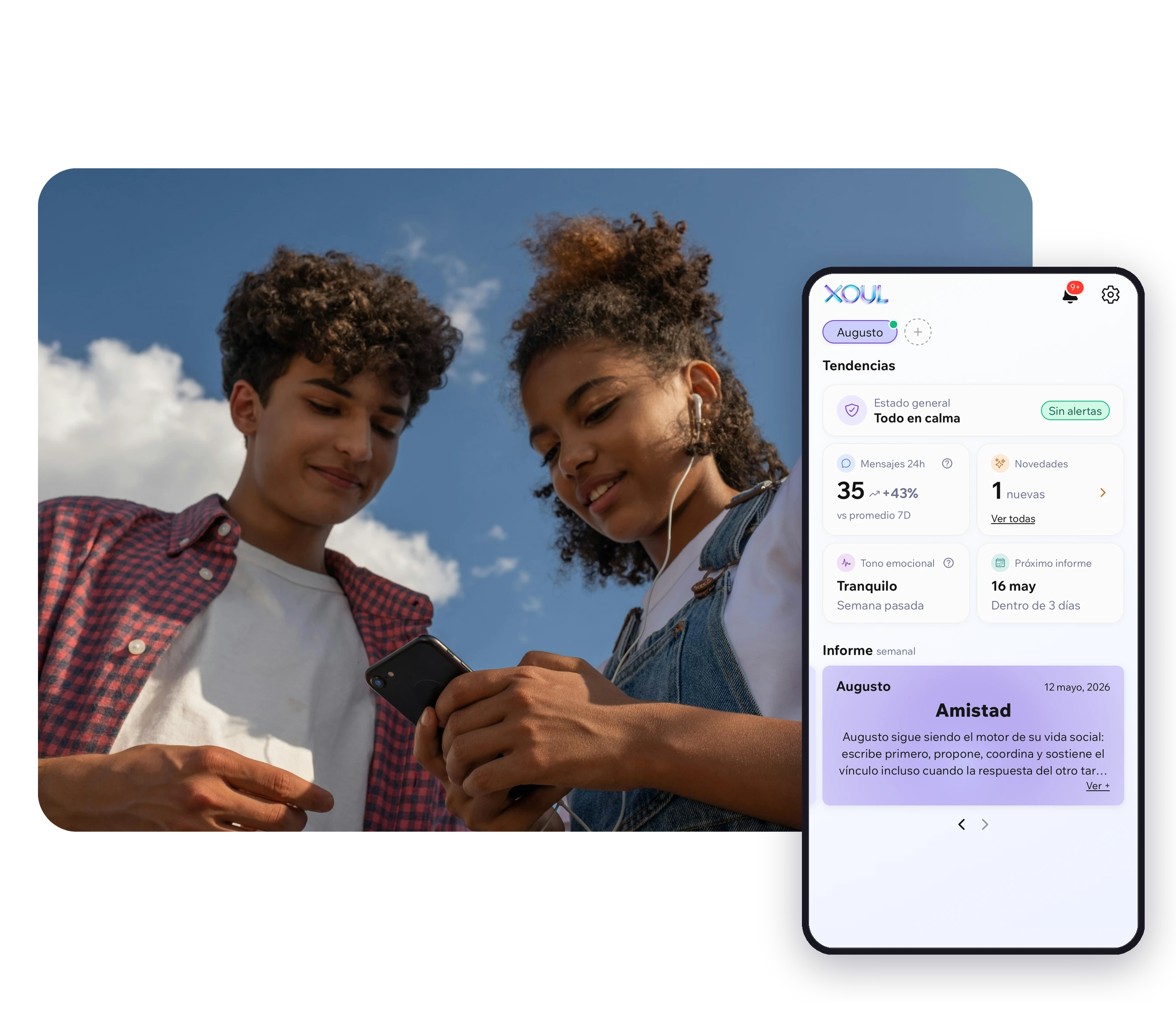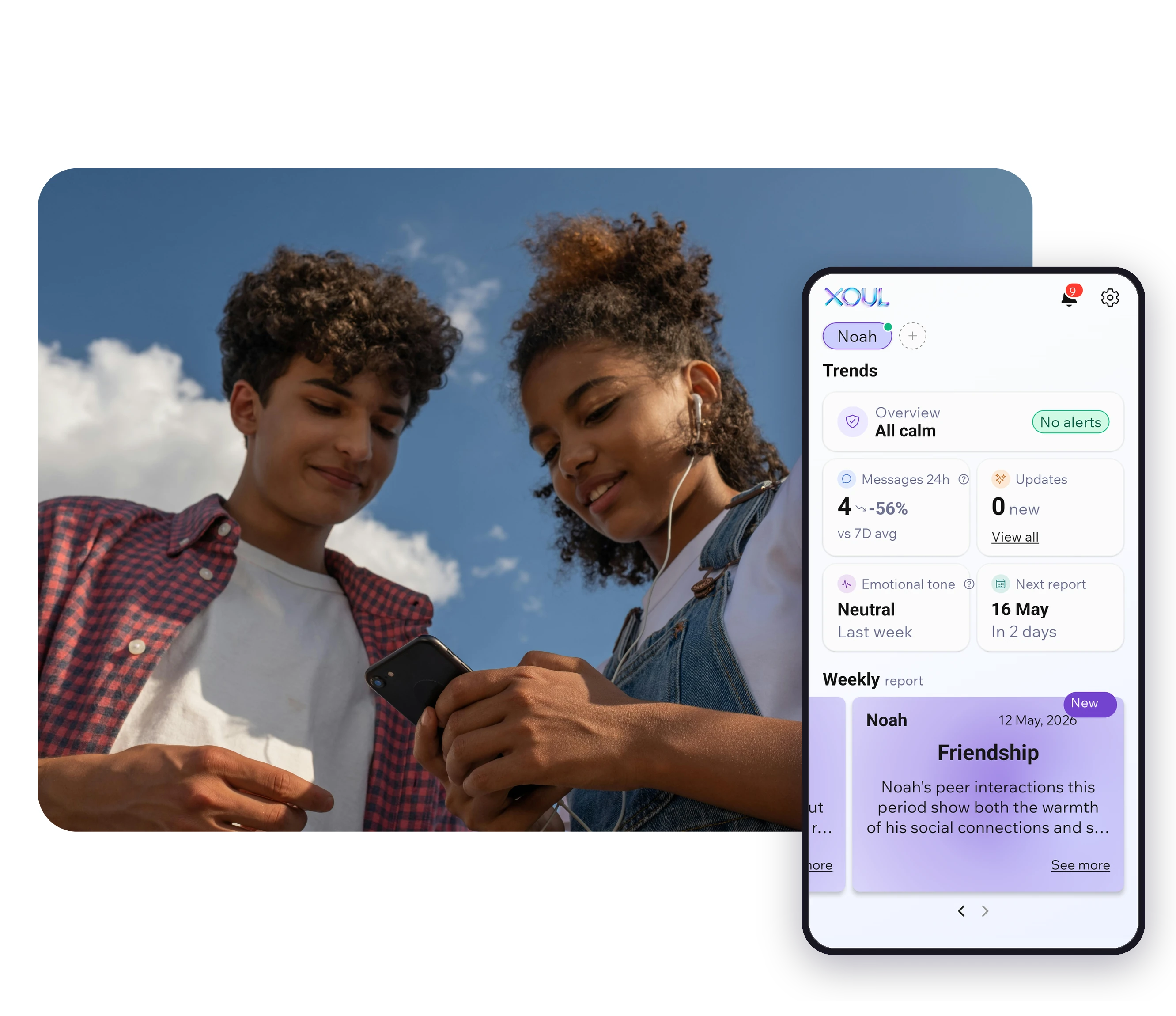
TL;DR. Parental accompaniment is a digital supervision model that prioritizes the minor's consent, the privacy of their message content, and family dialogue over surveillance and restriction. Unlike traditional parental controls, accompaniment gives the adult information about patterns, emotions, and potential risks without exposing the minor's literal conversations. It's especially suited for adolescents between 12 and 16, where pure control loses effectiveness and damages family trust.
Parental accompaniment is a way to supervise a minor's digital life without invading their privacy. Instead of reading messages, blocking apps, or restricting screen time, the adult receives interpreted information about the minor's emotional wellbeing, social relationships, and potential risks.
The term became popular from 2024 as an alternative to classic parental control, which was showing clear limits with adolescents: blocking tools work poorly past age 13, minors easily circumvent them, and family trust erodes.
Traditional parental control assumes the digital problem is solved by seeing everything and restricting what's wrong. It worked reasonably well in the 2010s, when minors had less technical sophistication and digital life was more contained.
Three changes shifted the landscape:
Parental accompaniment is born from accepting these three changes and building from there.
The minor knows they are being accompanied and, in many cases, gives explicit consent to activate the tool. This strengthens trust: transparency doesn't weaken protection, it reinforces it. A minor who understands and accepts the system respects it.
Instead of reading every message, the adult receives interpreted signals: emotional shifts, new connections, potential risks. You don't see what the minor said, but how they are. This distinction is central.
The tool doesn't replace conversation, it informs it. Reports are material for talking, not for judging. When a report indicates something changed, the parent talks with the minor instead of confronting them with specific content.
What works at 9 doesn't work at 14, or at 16. The accompaniment system evolves with the minor: less supervision depth as they grow, more autonomy, more dialogue.
| Aspect | Parental control | Parental accompaniment |
|---|---|---|
| Model | Restriction and surveillance | Information and dialogue |
| Message access | Literal reading or filtering | No access to content |
| Minor's consent | Optional | Required |
| Recommended age | 4-12 years | 8-16 years |
| Focus | Screen time, apps, content | Emotions, connections, risks |
| Trust impact | Risk of damaging it | Tends to build it |
| Effectiveness with teens | Low | High |
| Representative tools | Qustodio, Family Link, Mobicip | Xoul |
Accompaniment doesn't replace control in all cases. There are moments where control is the appropriate response:
In other cases, especially with adolescents, accompaniment delivers better medium-term results.
The parental accompaniment market is still nascent. The offering is smaller than that of traditional parental controls. Xoul is the main app built natively under this model: it analyzes WhatsApp with AI trained by a clinical team, delivers interpretive reports on emotions and connections, doesn't expose messages to the adult, and requires the minor's explicit consent to activate.
Other tools call themselves accompaniment but retain control elements (reading messages under certain conditions, hidden surveillance). When evaluating a tool, ask specifically: do parents read messages in any case? Is the minor's consent required to activate? Honest answers distinguish real accompaniment from marketing.
Step 1: Talk first, not after. Before installing any tool, talk with your child about why you want to accompany their digital life. Explain that it's not surveillance.
Step 2: Define the contract. What you'll see (patterns, alerts), what you won't (specific message content), what happens if you find something (you talk about it before acting).
Step 3: Choose aligned tools. Those that have the minor's consent as a requirement and don't expose messages. If the tool reads messages «under certain conditions», that's surveillance in disguise.
Step 4: Joint report review. Read reports with your child when they arrive. This educates about what's observed and reinforces transparency.
Step 5: Regular adjustments. Every 3-6 months, talk about how it's going. Do they feel spied on or accompanied? Constant adaptation is the key.
It can be used from age 8, but until ages 11-12 traditional parental controls remain appropriate and sufficient. Accompaniment makes more sense from puberty onward.
It's a necessary conversation, not a failure. If the minor rejects accompaniment, it's worth understanding why. Often it's distrust based on previous surveillance experiences. Dialogue opens the path.
Yes. Many families use Family Link for free for Android device management (screen time, location) plus Xoul for WhatsApp accompaniment. They cover different things.
The concept applies to any platform. Tools available today concentrate mainly on WhatsApp because that's where adolescent social life concentrates most, but the model scales to other platforms as they emerge.
The report alerts you without exposing the conversation. The correct action is to talk with your child from a position of care, not confrontation. If the situation is serious, you can involve a mental health professional together.
If you want to start applying parental accompaniment at home, Xoul offers the first report free, no credit card required, delivered in 10 minutes. Try Xoul free →
XOUL gives you private reports with risks, emotions and important moments, always from a respectful approach.