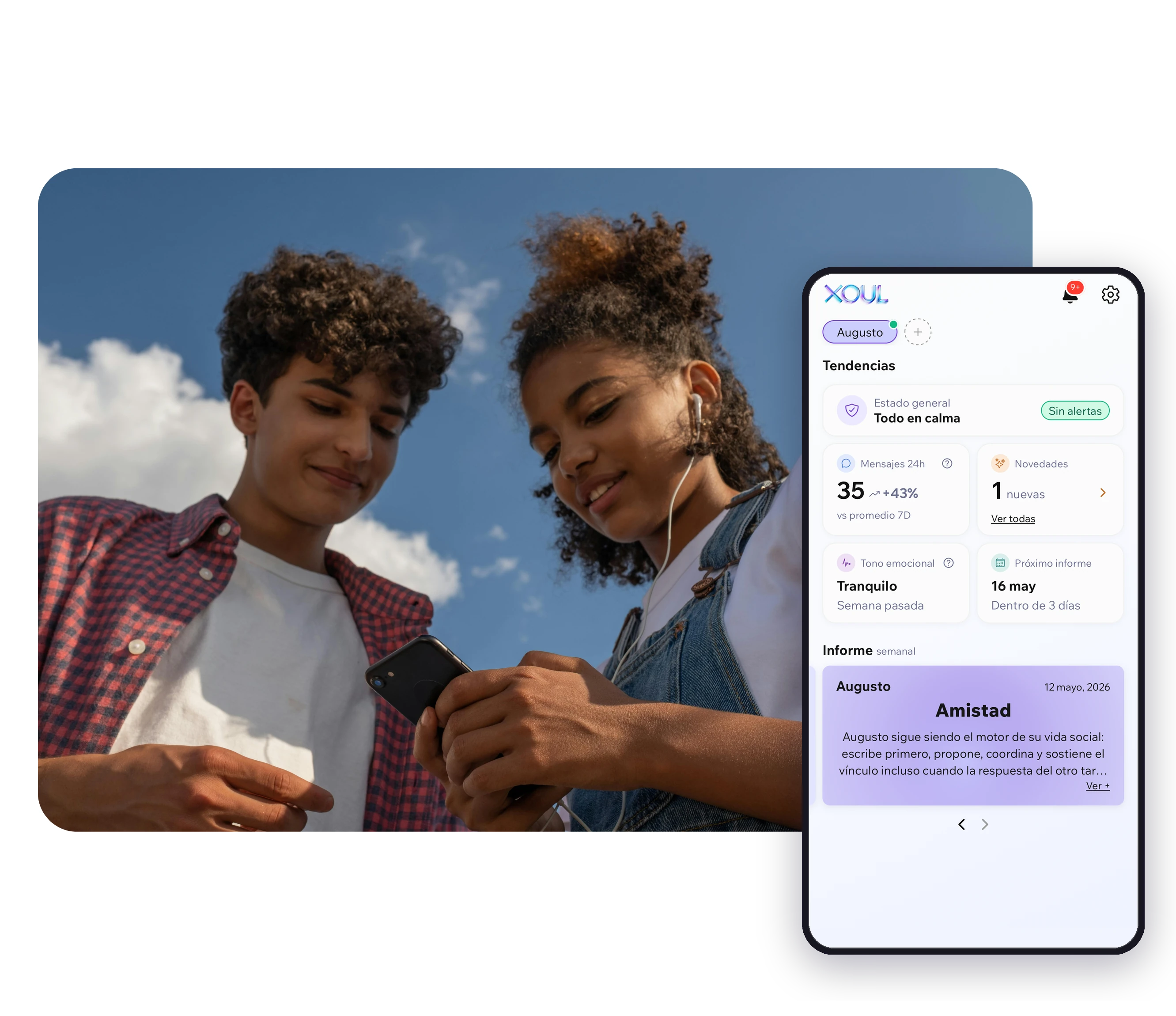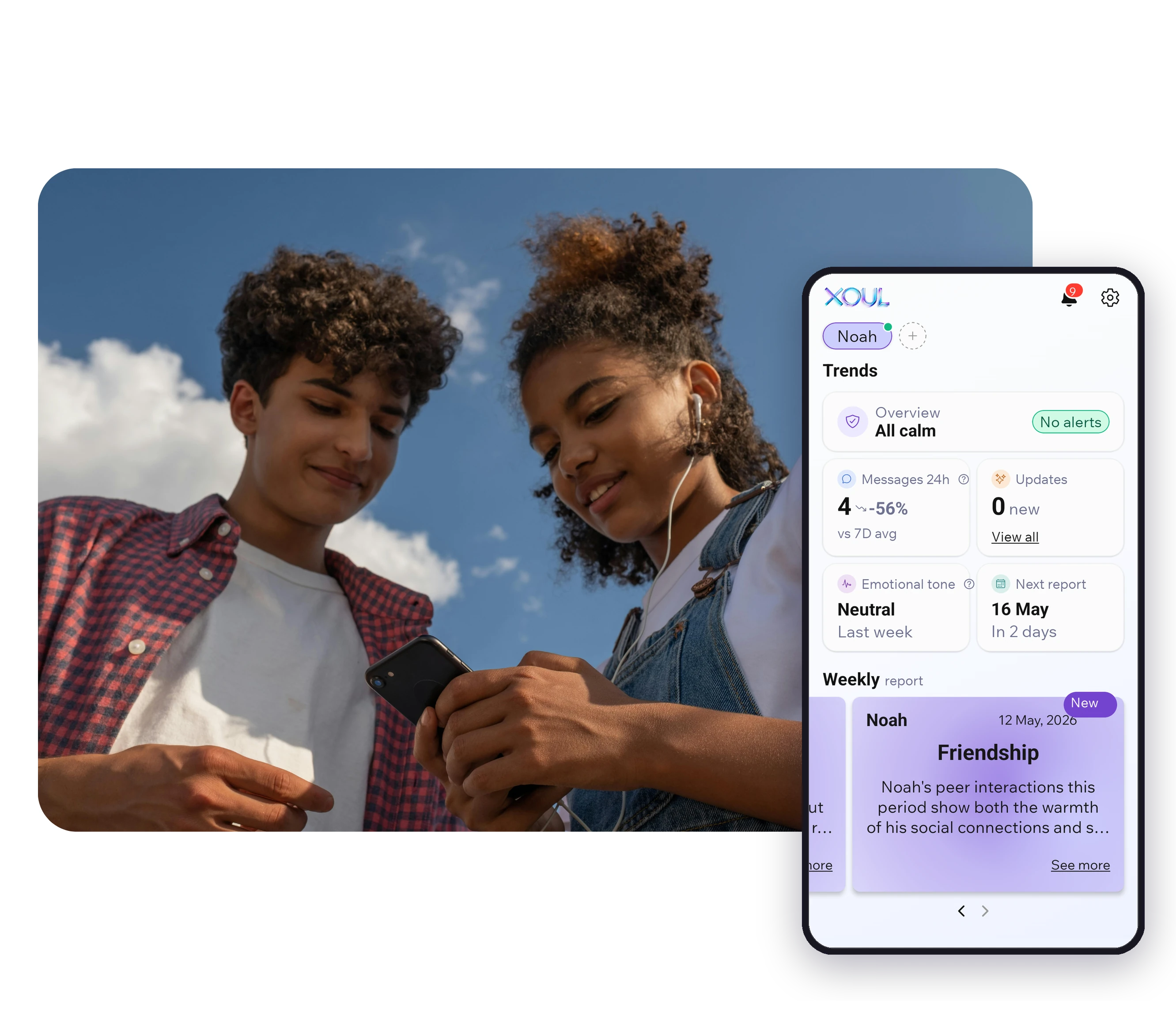

You want to know your child is okay. And you know a big part of their life happens on their phone: the class group chat, voice notes with friends, social media, weekend plans. The urge to take a look is real. But digital parenting isn't a choice between watching everything and knowing nothing. There's a middle path, and it's the one that works best.
This guide brings together what research says, which signs to watch, what to do if something worries you and how to talk about it at home, without reading their messages. Updated 20 October 2026.
In this guide:
Digital parenting means being there for your child online too: knowing how they're doing, setting agreements that grow with their age and being the person they come to when something goes wrong. It isn't about watching every message. It's about keeping your connection strong in one more place where their life happens.
It changes with age. With an 8-year-old, it means using technology together and deciding which apps they have. With a 15-year-old, it's different: they need their own space, and your role shifts from close supervision to guidance from a distance, built on trust and clear agreements.
Three ideas hold at every stage:
Because what you know about your child depends mostly on what they tell you, and snooping makes them tell you less. Research has shown this for decades: when young people feel their privacy has been invaded, they become more secretive, and their parents end up knowing less, not more.
A landmark study of 14-year-olds in Sweden found that what best explained how much parents knew about their lives wasn't control or questioning, but what teens chose to share on their own (Kerr and Stattin, Developmental Psychology, 2000). Years later, a team in the Netherlands found the same thing from the other side: when teens felt their privacy was being invaded, a year later they kept more secrets and their parents knew less about them (Hawk et al., Developmental Psychology, 2013).
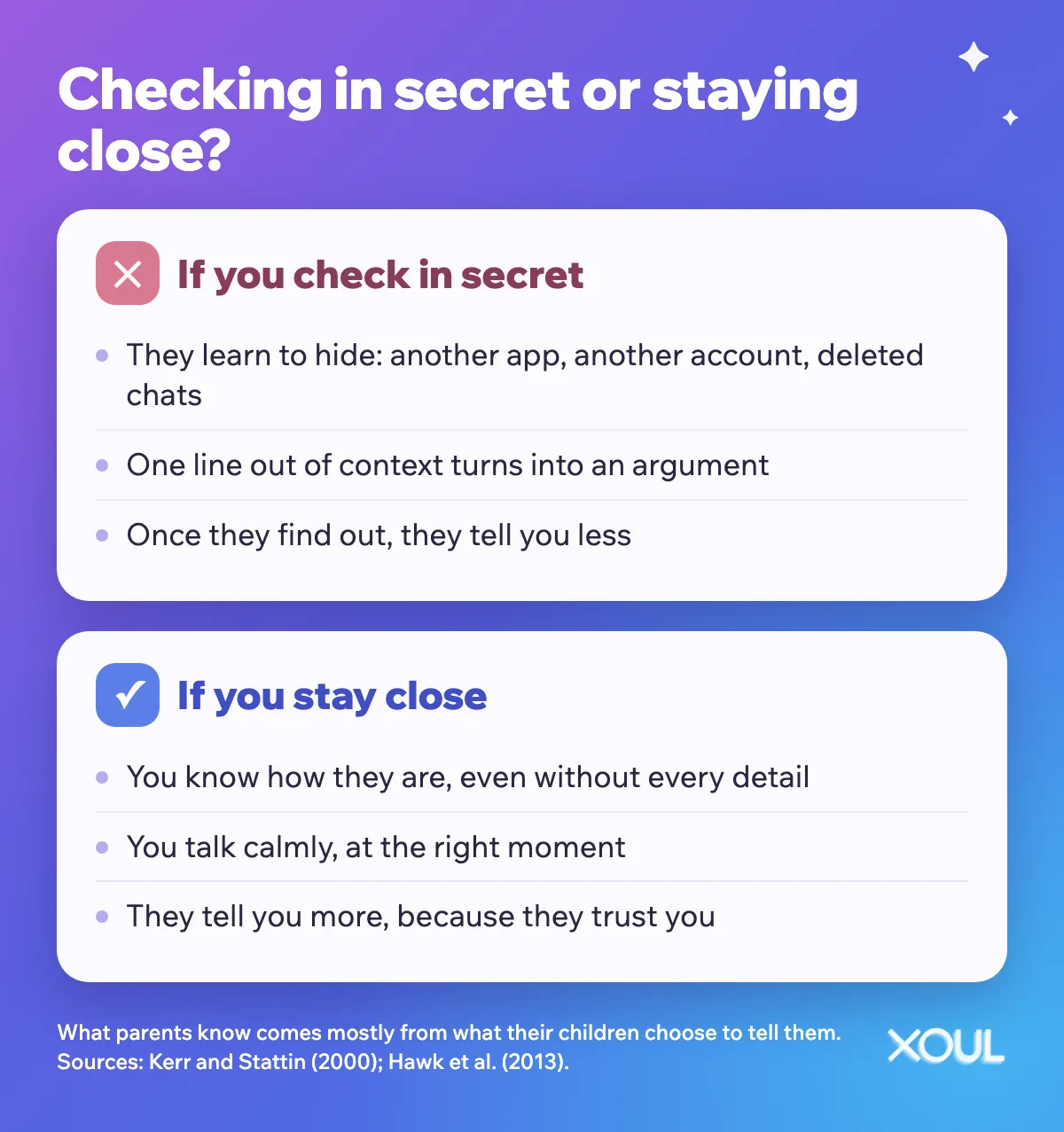
In practice, when a parent reads messages in secret, one of these usually happens:
eSafety also points out that no parental controls are 100% effective, and that children can find ways around them. That's one more reason the conversation matters more than the settings. If you're wondering what each option actually shows you, we cover it in how to know how your child is doing without reading their messages.
In the teen years, the phone becomes the centre of their social life: it's where plans get made, where conflicts get sorted out (or start) and where they look for a sense of belonging. Seeking independence comes with this stage, and wanting more privacy is a normal part of growing up, not a sign that something is wrong.
Messaging is a big part of that. In the US, about a quarter of teens aged 13 to 17 (24%) now use WhatsApp, up from 17% in 2022, according to Pew Research Center. In Australia, WhatsApp isn't covered by the under-16 social media minimum age, so WhatsApp's own minimum age of 13 still applies (eSafety).
What's worth watching isn't whether they use social media, but what happens to them there:
| What happens on social media and in chats | Why it matters | How to support them |
|---|---|---|
| Social pressure and comparison | It can affect how they see and feel about themselves | Talk about social media being an edited version of life, and about how their worth doesn't depend on likes |
| Conflict in class group chats | It can spill over offline | Ask about their friendships, not just their phone |
| Messages from strangers | Some people want more than a chat | Agree on what to do: don't reply, block and tell you |
| Late-night use | It can affect their sleep and mood | Agree on a time when the phone stays out of the bedroom |
If their social life runs mostly through WhatsApp, our guide to WhatsApp for kids covers the minimum age, the privacy settings to set up together and what to do about group chats.
Look for changes that last: in sleep, mood, eating, wanting to see friends or go to school, and how they seem after using their phone. A bad day is part of growing up. What deserves a conversation is a change that sticks around for weeks.
| Expected | Worth a chat | Worth talking to a professional |
|---|---|---|
| Wants more privacy and spends more time chatting with friends | Seems low or more irritable after using their phone | Big changes in sleep or eating that last for weeks |
| One-off arguments in a group chat | Stops mentioning a group or a friend they used to talk about | Withdraws from everything, stops going to school or talks about self-harm |
| Mood goes up and down from day to day | Suddenly hides their phone or gets very anxious when a message arrives | Receives threats, blackmail or pressure to send photos |
Here's some good news: most of what happens in their chats is everyday life. In August and September 2026, 87 in every 100 signals Xoul picked up in WhatsApp conversations were positive or neutral. And for every bullying signal, there were 63 signals of everyday peer conflict, the kind that's part of growing up. In a Xoul report you see trends like these, not single messages.

Xoul is a parental support app: with your child's consent, it connects to their WhatsApp and gives you reports on how they're doing. It doesn't show you their messages; it shows you how they are. That way you know when to check in and how to start the conversation.
Here's how it works:
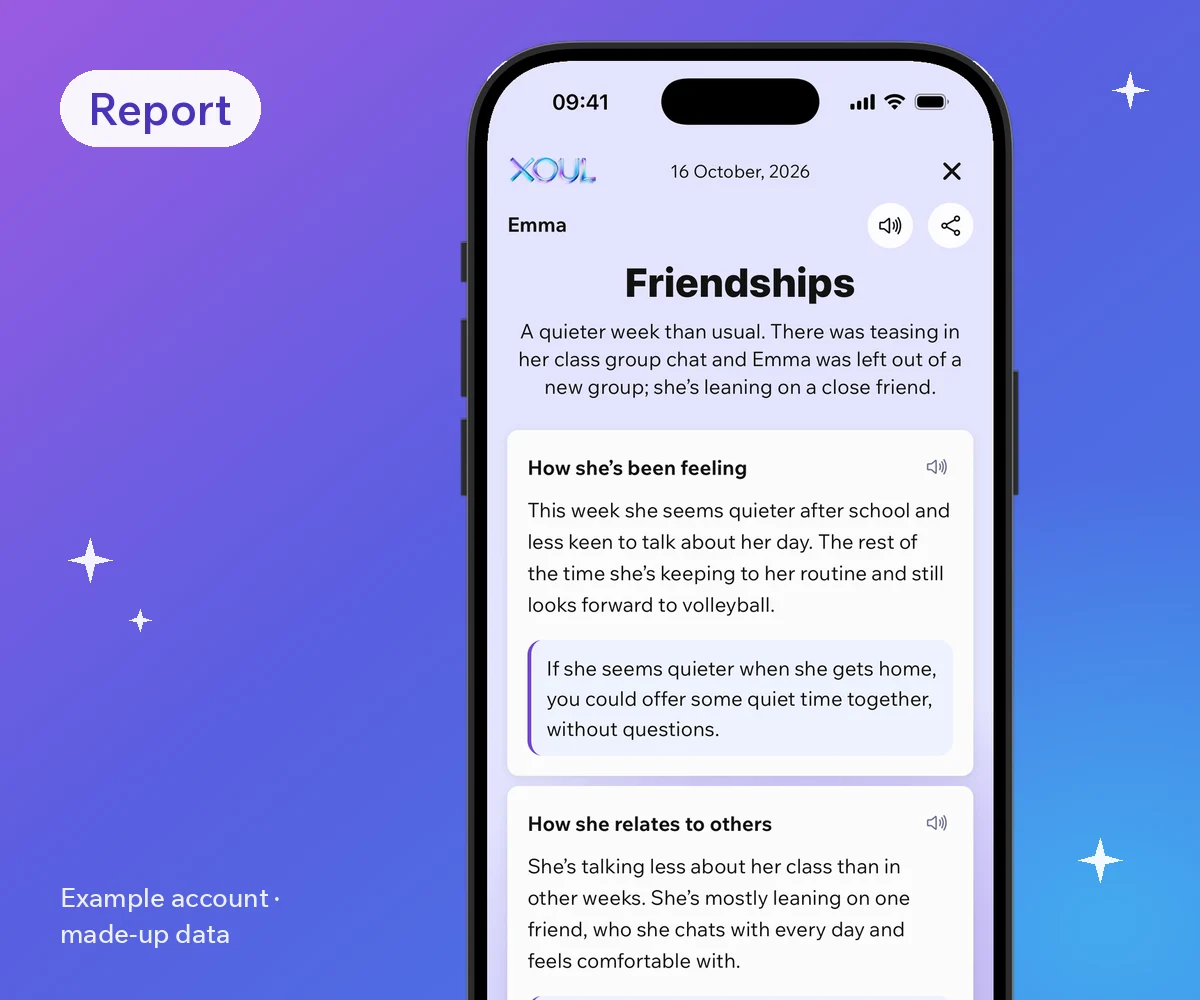
If you're wondering whether this is just spying by another name, we answer that in detail in Does Xoul spy on my child? How it really works. Xoul is designed for children aged 8 to 16 who already use WhatsApp.
First, take a breath: a signal is an invitation to get closer, not proof of anything. Pick a calm moment, start with how they are rather than what you saw or suspect, and listen before suggesting anything. If their safety or health is at risk, get professional help straight away.
A few steps that help:
Xoul helps with this step. If something deserves attention, it may appear in the report or in Updates, labelled "Attention", with a suggestion for how to talk about it. It isn't a real-time alarm: it's context, so you can come to the conversation calmly.

Be upfront, and do it before anything happens: tell them what worries you, what you won't do (read their messages in secret) and what you'd like from them (to tell you if something makes them uncomfortable). Ask what they think and agree on the rules together. A conversation like that builds more trust than any phone check.

If you're going to use Xoul, this conversation is the first step, because it won't connect without their consent. Explain that you won't see their messages, that the report is about how they are and not about what they write, and that the idea is to be able to help if something happens. There's a script you can use in how to talk to your child about Xoul.
Three things it often helps to say:
From their very first device, even before they have a phone of their own. Conversations about limits, privacy and feelings online work best when they're ongoing and grow with your child, rather than appearing suddenly once there's already a problem.
Checking it in secret tends to damage trust and, according to research, leads them to tell you less. If you ever need to look at something for their safety, do it with their knowledge and explain why.
No. Nobody in the family sees their chats. Xoul analyses text and voice notes (not images), creates signals and then deletes the messages. You get a report on how they're doing, not a log of their conversations.
No. Xoul isn't a real-time alarm. Anything that deserves attention may appear in the report or in Updates, along with an idea for how to talk about it.
Children aged 8 to 16 who already use WhatsApp. Parent-managed WhatsApp accounts (for under-13s) don't support linked devices, so Xoul can't connect to them.
Digital parenting isn't about knowing everything. It's about knowing what matters and being there. With clear agreements, regular conversations and tools that respect their privacy, you can look after your child without spying.
Your first Xoul report is free and arrives in about 10 minutes. Download Xoul and start supporting your child, without reading their messages.
XOUL gives you private reports with risks, emotions and important moments, always from a respectful approach.