TL;DR. No, Xoul doesn't spy. Xoul is a parental accompaniment app where artificial intelligence accesses your child's WhatsApp conversations under a strict privacy approach: it analyzes emotional patterns, relationships, and possible risks, and delivers interpreted reports without exposing a single conversation. Your child gives consent when connecting their account. The clinical team trains the technology. You never read what they write or receive.
When a parent hears "app connected to my child's WhatsApp," the first reasonable reaction is: so I'm going to read everything? Or worse: is this disguised surveillance? It's a fair question. The answer matters because it marks two very different product categories:
Step 1 — Your child accepts and connects their WhatsApp. The process begins with a family conversation. You decide to use Xoul, you explain to your child what the tool does and why you want to use it. If they agree, they connect their WhatsApp by scanning a QR code from their own phone, similar to WhatsApp Web. The connection requires their active action. There is no way to install Xoul without the minor's explicit consent.
Step 2 — The AI processes the conversations. Once connected, messages that enter and leave your child's WhatsApp are analyzed by our artificial intelligence. Processing is automated and pursues three objectives: identify predominant emotions, map active digital relationships, and detect risk signals like grooming, cyberbullying, sexting, substance use, or self-harm.
Step 3 — Data is anonymized and conversations are deleted. After analysis, original messages are deleted from our base. What remains are interpreted patterns, not transcripts.
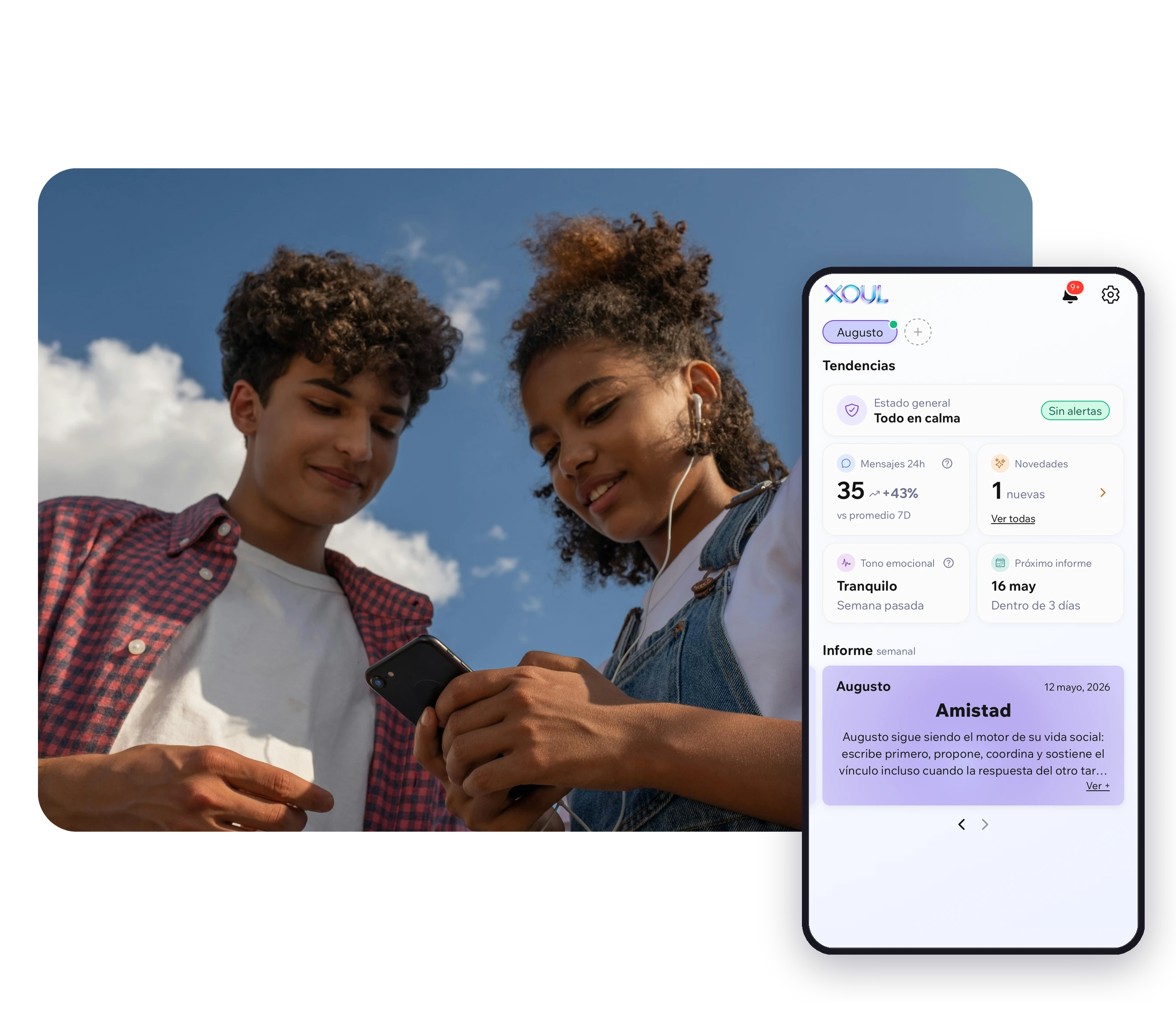
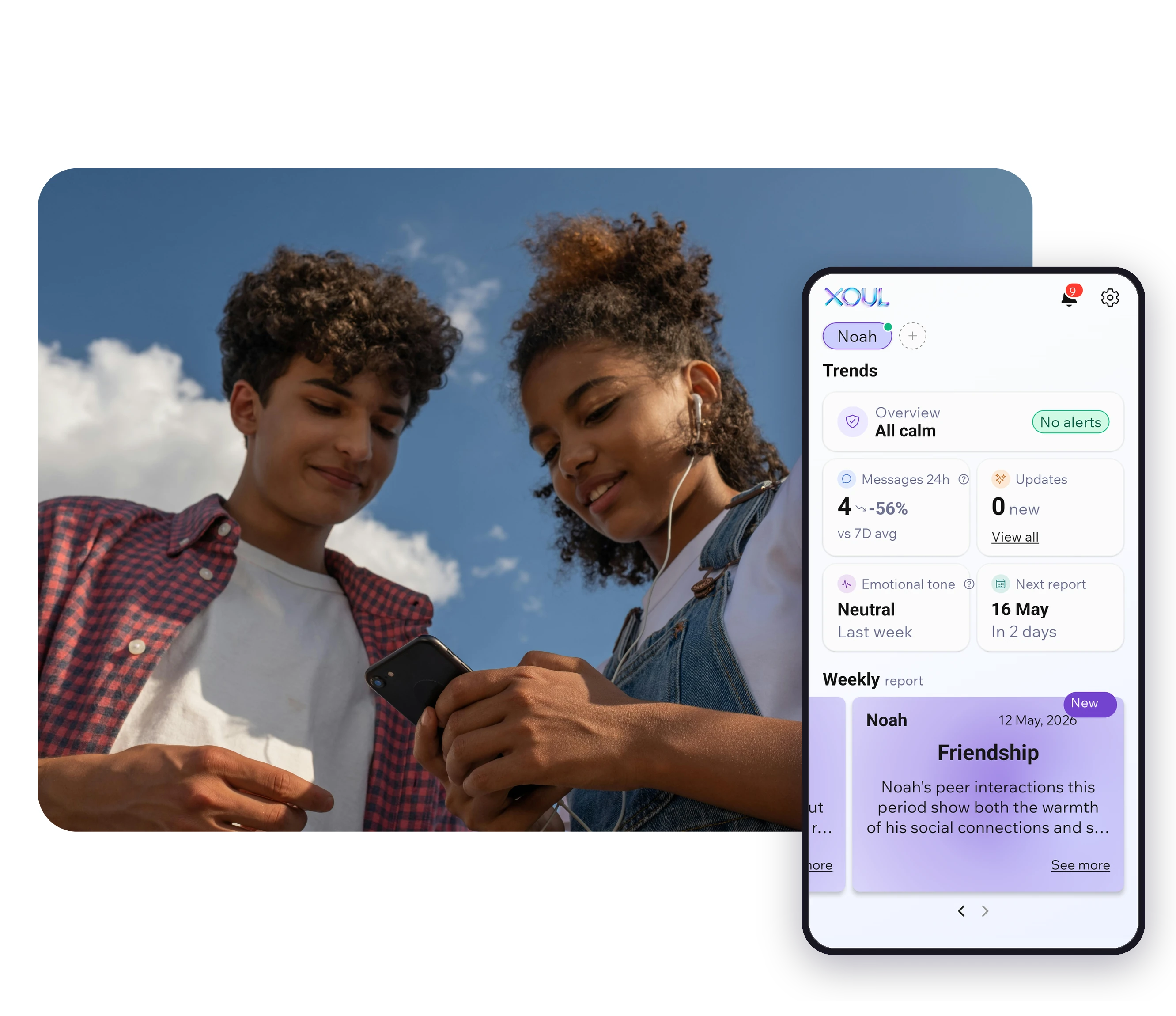
Step 4 — You receive reports and alerts, not messages. As the adult in charge, you receive a trends dashboard, daily updates on relevant situations, complete reports every 4 days, immediate alerts for urgent situations, and access to the Xoul conversational agent.
Step 5 — Your child can disconnect Xoul at any time.
The minor has the right to privacy and the adult has the responsibility to protect. Both are compatible only if the tool interprets without exposing.
1. Evidence on parental surveillance. Research in developmental psychology shows consistent patterns in adolescents whose phones were checked without consent: decreased communication with parents, migration to more private platforms, greater likelihood of hiding real problems. Surveillance intended to protect ends up exposing more.
2. The minor's right to privacy. The UN Convention on the Rights of the Child (1989) establishes in Article 16 the right of children and adolescents to the protection of their private life.
3. Clinical effectiveness. Our team of psychologists validated from the start that aggregated and interpreted information produces better family conversations than direct content access.
Think of a concrete situation. Your 13-year-old starts to show an emotional change. They're quieter, more reserved, seem worried.
Without Xoul, your information comes from what they tell you, what you see in their behavior, or what you discover if you decide to check their phone.
With Xoul, you receive a report identifying precise emotions: "This week we detected sustained sadness, anxiety, and insecurity in your child, especially linked to a new contact from the last month. We suggest: 1) ask about that new relationship from curiosity, not suspicion; 2) create a screen-free moment this week to talk about how they feel with their friendships; 3) if the situation persists, consider talking to a mental health professional."
You don't know what they said, or to whom. You know what you need to know to accompany, with concrete actions.
| Aspect | Traditional parental control | Xoul (accompaniment) |
|---|---|---|
| Access to messages | Total | Never exposes content |
| Minor's consent | Optional | Required |
| Information you receive | Raw data | Interpreted patterns |
| Main function | Block, restrict, surveil | Detect, inform, accompany |
| Risk of breaking trust | High | Low |
To be clear: at Xoul, the clinical team does not produce reports or one-on-one recommendations. What it does is continuously train the artificial intelligence through a human in the loop process:
Your specific report was not written by a psychologist. It was written by an AI whose criteria was shaped by psychologists across thousands of iterations.
Risk detection in Xoul is technology in continuous development. It can make errors or omissions. Xoul does not replace:
If the question "Does Xoul spy on my child?" brought you to this post, the short answer is: no. And the long answer is that we designed Xoul precisely so that it is possible to accompany your child's digital life without invading their privacy or breaking their trust.
Your first report is free and arrives in 15 minutes. No credit card required.
Get your first free report. Receive it in 15 minutes.
XOUL gives you private reports with risks, emotions and important moments, always from a respectful approach.