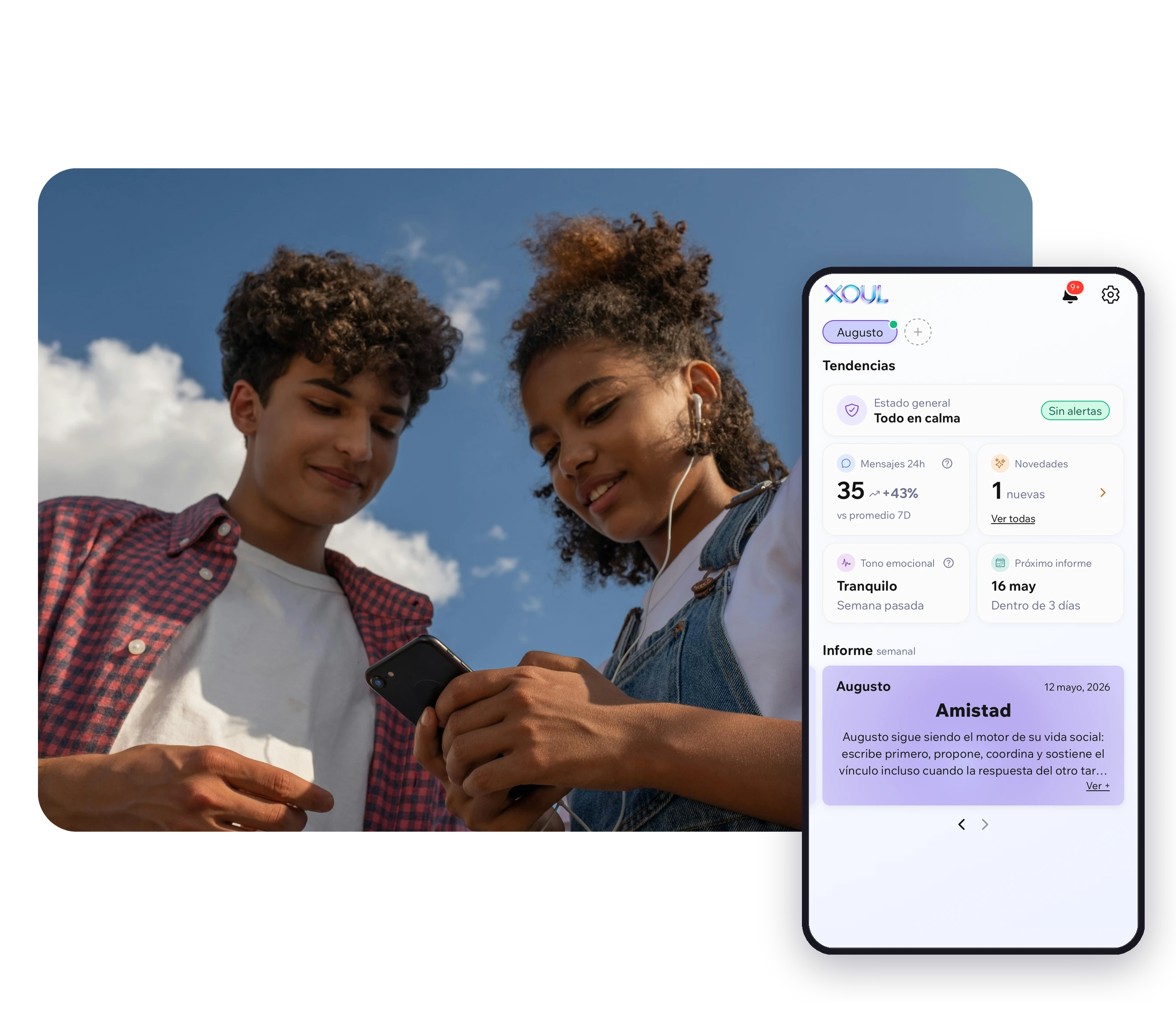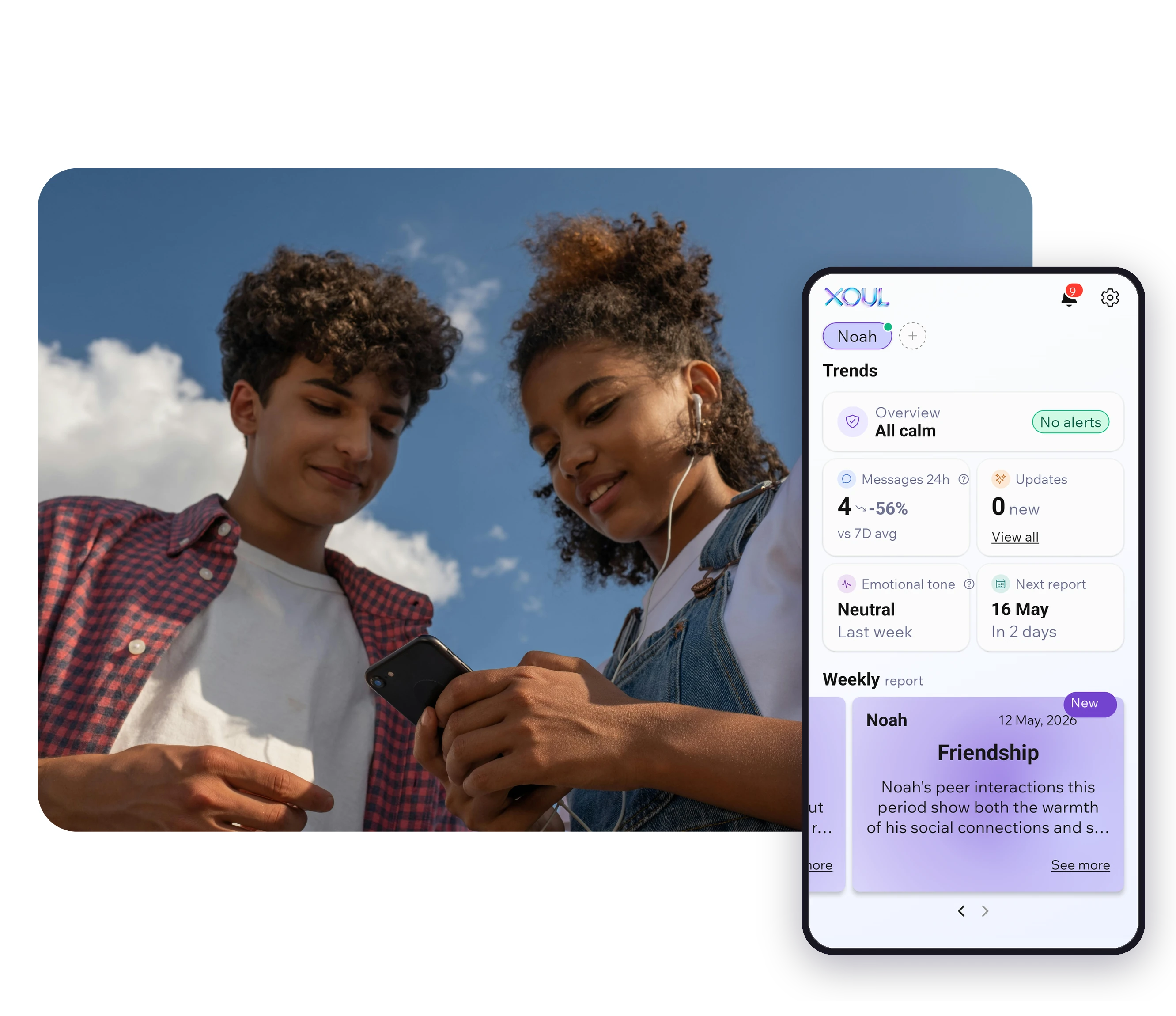
TL;DR. Xoul Insights 2026 aggregates public data on adolescent digital usage, prevalence of online risks, and adoption of parental control tools, complemented with product observations from Xoul across 17 countries. Headline findings: 97% of teens 13-17 own a smartphone, the average age of first phone keeps falling (10.3 years globally), 85% of Spanish-speaking teens use WhatsApp as their main social channel, traditional parental control loses effectiveness markedly past age 12, and the United Kingdom set a regulatory precedent in June 2026 by banning social media for under-16s while leaving WhatsApp accessible. This document is updated quarterly.
This report combines two sources:
The scope is families with teens ages 8 to 17. Data on adult use or on children under 8 is not included. The geographic coverage of internal observation is skewed toward Latin America, Spain, Mexico, Argentina, and Colombia.
97% of teens 13-17 in developed markets own a smartphone (Pew Research Center, 2023, updated 2025).
10.3 years is the global average age of first smartphone in 2025, vs. 11.6 in 2019 (Common Sense Census, 2025).
85% of Spanish-speaking teens (Spain, Mexico, Argentina, Colombia) use WhatsApp as their main social channel. WhatsApp surpasses Instagram, TikTok, and Snapchat in daily usage frequency in those markets (GSMA Intelligence + Xoul observation, 2026).
1 in 5 teens experienced some form of cyberbullying in the last 12 months (Pew Research Center, 2024).
1,300% growth in reported sextortion of minors between 2020 and 2024 globally. Most affected segment: boys ages 13 to 16 (FBI + Internet Watch Foundation, 2025).
76% of financial sextortion cases escalate from first contact to threat in less than 24 hours (Thorn, 2024).
1 in 9 minors has received an unwanted sexual solicitation online (Crimes Against Children Research Center, updated 2025).
54% of parents with kids 8-17 report using at least one parental control tool (Common Sense + OFCOM, 2025).
Effectiveness by age based on cross-referenced Xoul observations + industry peers:
| Minor's age | Perceived effectiveness of traditional control | Circumvention rate self-reported by minors |
|---|---|---|
| 4-7 | 92% | 3% |
| 8-11 | 78% | 14% |
| 12-14 | 41% | 52% |
| 15-17 | 19% | 74% |
Source: aggregated Xoul observations + Pew Research 2024.
The inflection happens between ages 11 and 12. In that range, more than 50% of minors already know at least one circumvention method (second account, VPN, alternative device, app tweaks).
Xoul defines parental accompaniment as digital supervision with three structural requirements:
Xoul product observations, March 2024 to May 2026:
June 15, 2026: the United Kingdom announces a social media ban for under-16s. Affected platforms: Instagram, TikTok, Snapchat, X, Facebook, YouTube. WhatsApp is excluded as it is considered private messaging.
This consolidates a trend already in motion:
The pattern repeats: regulatory pressure on social media coexists with accessible WhatsApp, concentrating adolescent social life even more in messaging. This reorders the parental accompaniment question toward the platform where the bulk of interaction is now concentrated.
62% of teens 13-17 believe their parents don't understand how their digital life works (Common Sense, 2024).
71% hide at least one app or conversation from their parents (Pew Research, 2024).
Only 23% of teens would go to their parents first in case of a serious online incident; 41% to a friend, 18% to no one (UNICEF Digital Lives, 2025).
The gap narrows in families that maintain regular dialogue about digital life without resorting to hidden surveillance.
Journalists, researchers, and content creators may freely cite data from this report. Suggested format:
Source: Xoul Insights 2026. Available at https://xoul.me/en/blog/xoul-insights-2026
For data derived from tertiary sources (Pew, Common Sense, OFCOM, UNICEF, FBI, Thorn, IWF, GSMA, Crimes Against Children Research Center), cite the original source where possible.
For internal Xoul data, cite as «Xoul product observations, March 2024 – May 2026».
Xoul Insights is updated quarterly. Next update planned: September 2026.
For questions, data not included, or press requests: press@xoul.me.
If you want to apply parental accompaniment at home, Xoul offers the first report free, no credit card required, delivered in 10 minutes. Try Xoul free →
XOUL gives you private reports with risks, emotions and important moments, always from a respectful approach.