AI fake nudes at school: what they are, what the law says and how to support your child
16/10/26
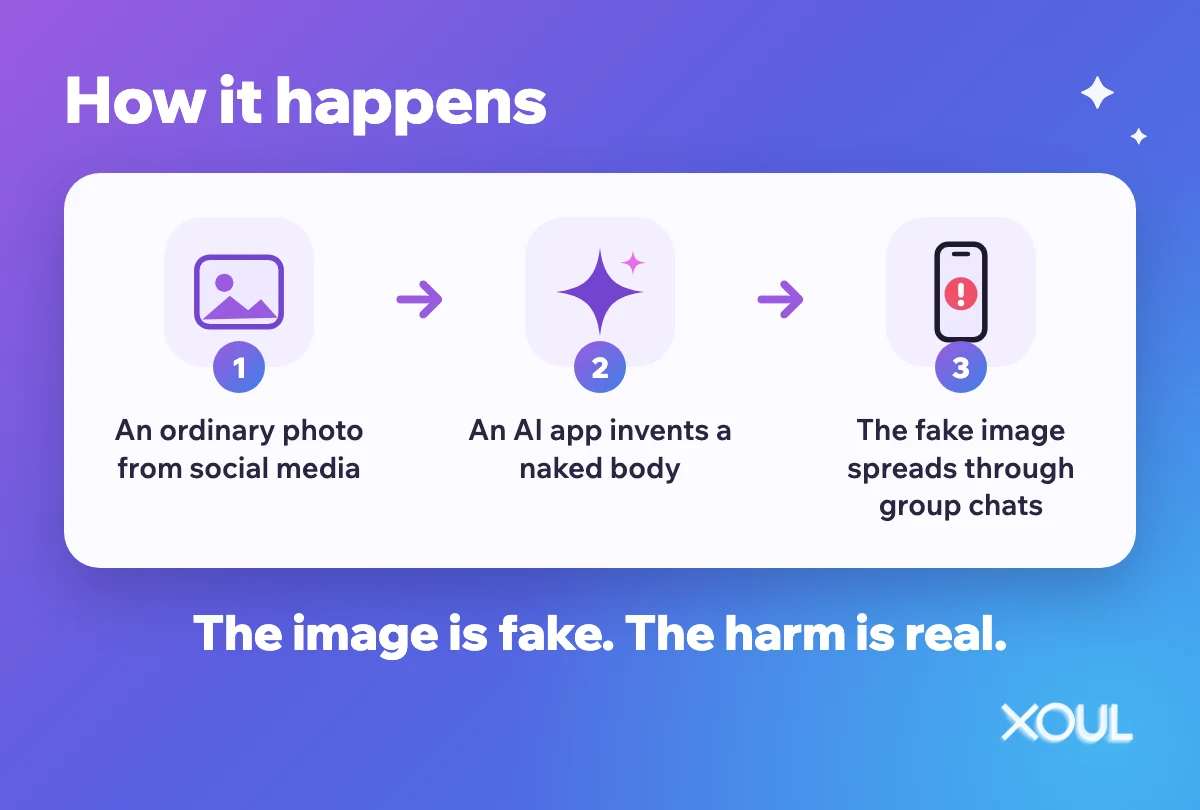
A profile photo from Instagram. A school photo. A shot in the team uniform. There's nothing wrong with any of them. But over the past three years, at schools in Australia, the UK and the US, students have used photos like these to make AI-generated nude images of their classmates that never existed, and passed them around in group chats, on Snapchat and Instagram, and sometimes beyond.
The images are fake. The harm is not. This guide is for parents, carers and teachers who want to understand what's happening, what the law says and, above all, how to support young people, whatever their place in the story: the one who is targeted, the one who receives the image, or the one who made it.
Content note: this article discusses digital sexual abuse of children and teenagers. It contains no images or explicit descriptions.
What a sexual deepfake is (and why it's not "just a joke")
A deepfake is an image, video or audio clip created or altered with artificial intelligence so that it looks real. A sexual deepfake takes the face of a real person and puts it on a naked body or in a sexual scene that never happened.
In school cases, two kinds of tools tend to come up:
"Nudify" apps and bots: from an ordinary, clothed photo, the AI invents a naked body.
Face swapping: someone's face is pasted onto an existing sexual image or video.
What AI changed isn't the intent, which is old, but how easy it has become: you no longer need any editing skills. That's why these cases now show up among secondary and even primary school students.
Even though the image is fake, when the person shown is under 18, it is child sexual abuse material. UNICEF puts it plainly: "Sexualised images of children generated or manipulated using AI tools are child sexual abuse material" (UNICEF, February 2026). As you'll see below, the law increasingly treats it that way too.
How common is it?
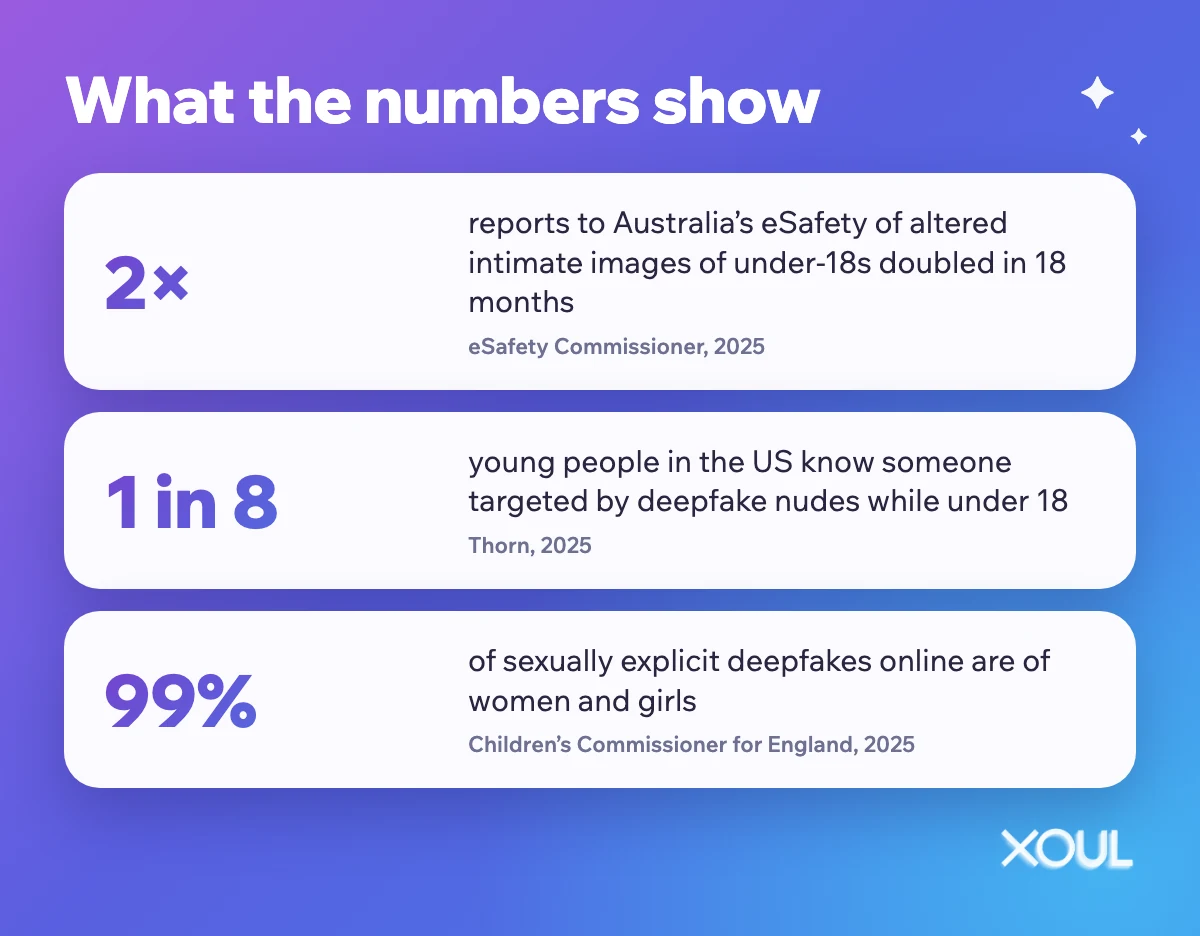
Australia: reports to the eSafety Commissioner of digitally altered intimate images of under-18s "have more than doubled in the past 18 months, compared to the total number of reports received in the seven years prior", and four out of five involved girls (eSafety, June 2025). By September 2025, eSafety was describing deepfake abuse "erupting across Australian schools almost weekly" (eSafety).
UK: the Children's Commissioner for England found that 99% of sexually explicit deepfakes online are of women and girls (Children's Commissioner, April 2025). The Internet Watch Foundation identified 3,443 AI-generated child sexual abuse videos in 2025, compared with just 13 the year before (IWF).
US: in a survey of 1,200 young people aged 13 to 20, 1 in 8 knew someone who had been targeted by deepfake nudes while under 18, and 1 in 17 had been targeted themselves (Thorn, March 2025).
Worldwide: across 11 countries studied by UNICEF, ECPAT and INTERPOL, at least 1.2 million children said their images had been turned into sexual deepfakes in the past year. In some countries that's 1 in 25: one child in a typical classroom (UNICEF, February 2026).
The pattern is the same everywhere: most of the young people targeted are girls, and those who make or share the images are usually classmates from the same school.
Real cases
All of these were reported by reputable news outlets or by the schools and authorities involved. Several investigations are still open; nobody named in an open investigation has been found guilty.
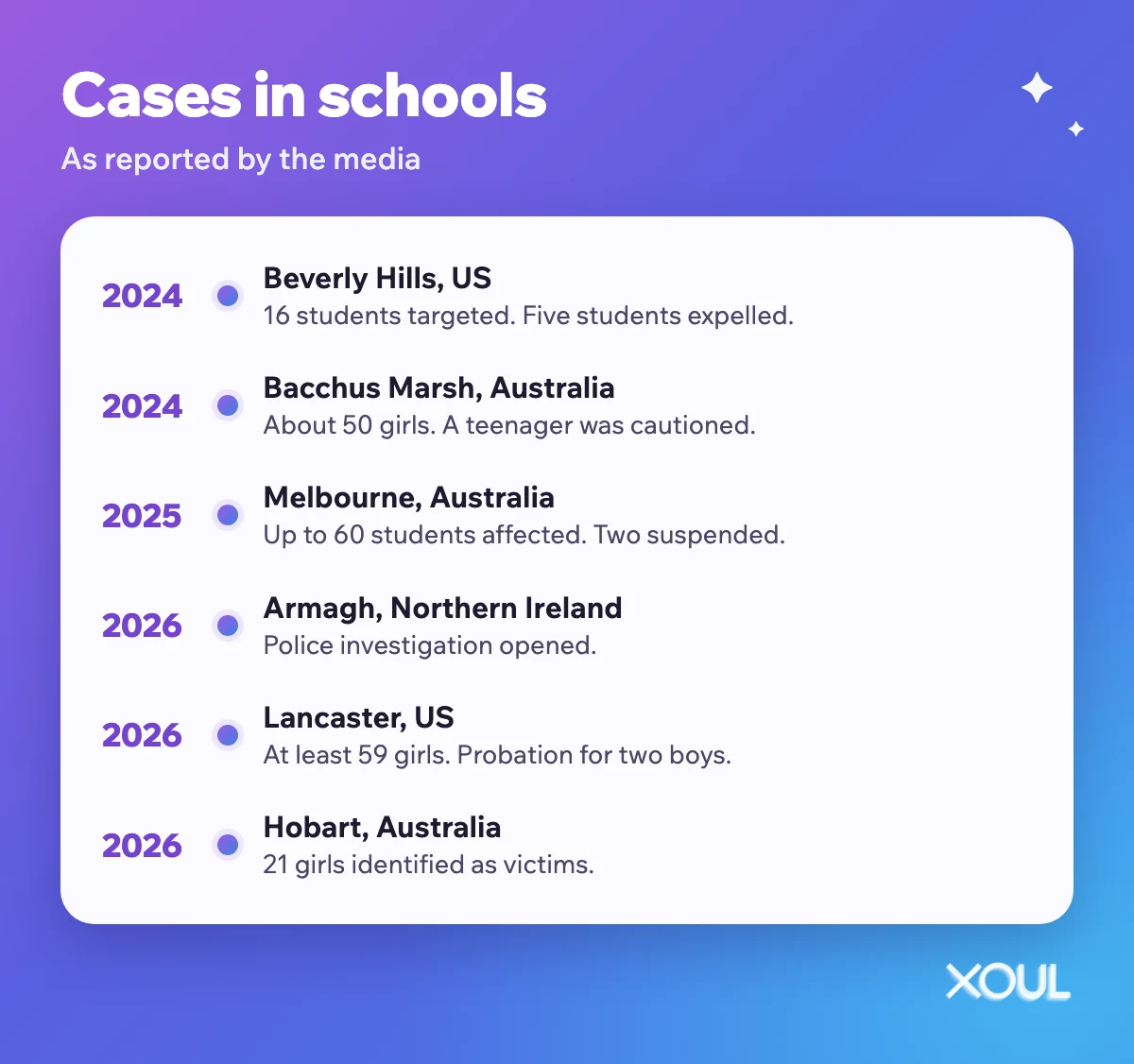
Australia — Bacchus Marsh, Victoria (2024). In June 2024, about 50 girls in Years 9 to 12 at a school in Bacchus Marsh, near Melbourne, had their faces taken from social media and manipulated with AI into "obscene photographs" that were shared online (AAP). A teenage boy was arrested and later issued with a police caution (ABC, February 2025).
Australia — Melbourne and Hobart (2025–2026). In February 2025, two Year 11 students at a secondary school in Melbourne's north were suspended after photos were "inappropriately manipulated using artificial intelligence technology"; a detective said as many as 60 students could be affected (ABC). In April 2026, parents at a school in Hobart said police had identified 21 girls as victims; five boys left the school and no charges had been laid (ABC).
UK — Armagh, Northern Ireland (2026). In January 2026, police opened an investigation after images of pupils at a school in Armagh were manipulated. The principal said the school believed it had identified "all those of whom images had been manipulated and those allegedly responsible" (BBC).
US — Lancaster, Pennsylvania (2024–2026). Two boys, aged 14 at the time, admitted making about 350 images showing at least 59 girls under 18. In March 2026, a juvenile court gave them probation, 60 hours of community service each, a no-contact order and restitution (AP via WTOP).
US — Beverly Hills, California (2024). In February 2024, a middle school discovered AI-made fake nudes of 16 eighth-grade students, created by putting their faces on naked bodies. The school district expelled five students (CBS News).
The harm: the image is fake, the impact is real
Young people targeted by sexual deepfakes don't feel that "nothing happened because it isn't my body". What they go through is very close to what victims of real intimate images being shared go through:
Shame and humiliation, even though they did nothing wrong. Many girls feel that "everyone has seen me like that", and within their school that may be true.
Anxiety, fear and trouble sleeping. In the cases above, parents describe panic, nausea and tears.
Withdrawal: not wanting to go to school, leaving group chats, closing accounts, no longer posting photos.
Loss of control: not knowing who has the image, how many copies exist or where it will turn up next.
Being blamed: comments, jokes, questions, and sometimes adults asking "why did you post that photo?"
And then there's the silence. In Thorn's survey of young people in the US, 62% of those who hadn't been targeted said they would tell a parent if it happened to them, but among those who had, only 34% did (Thorn, March 2025). That silence is what we can change most at home.
What the law says
Laws in this area are changing fast. This summary reflects the position in October 2026 and is not legal advice.
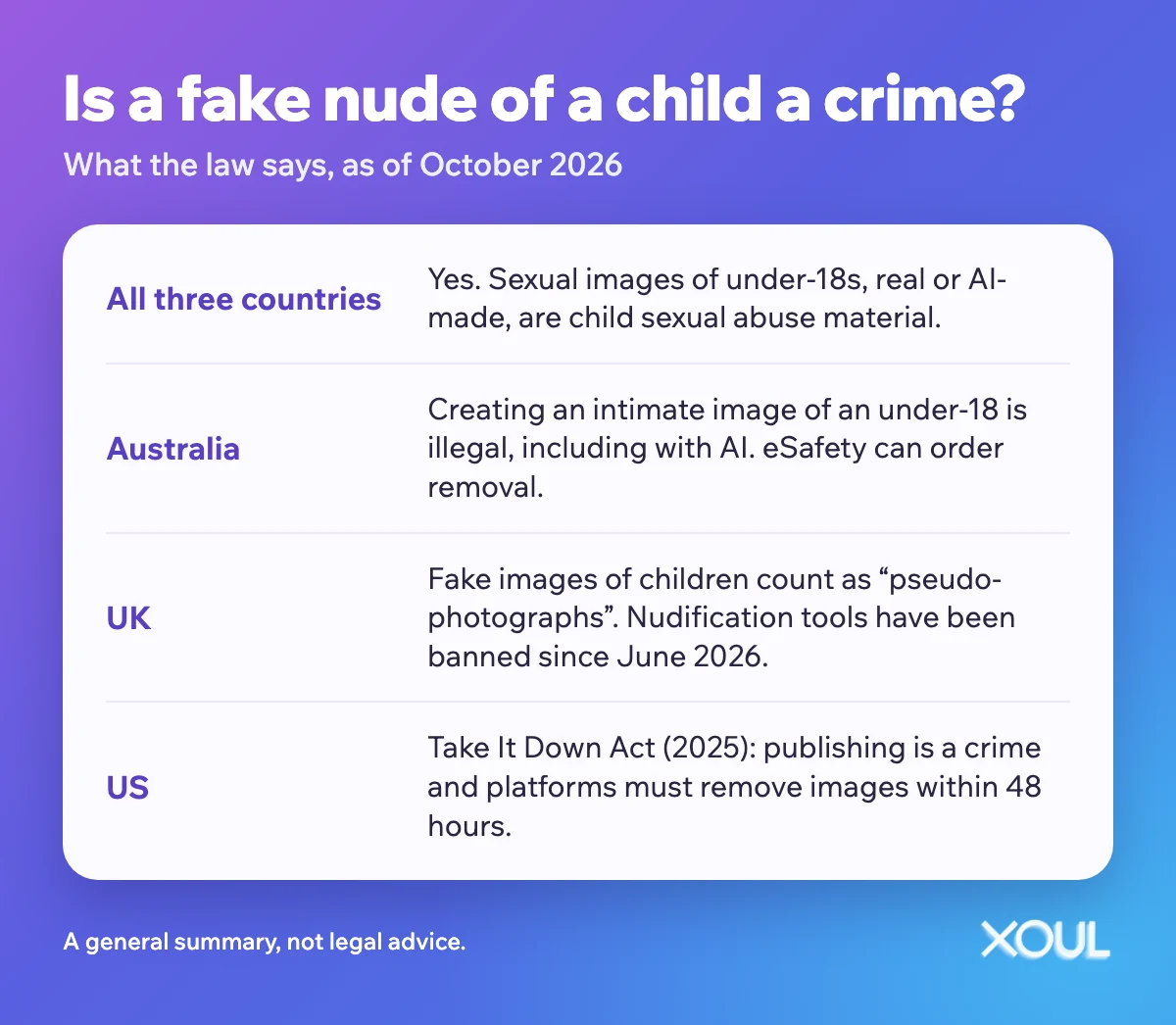
One point applies in all three countries: when the person shown is under 18, the image is treated as child sexual abuse material, whether it was photographed, edited or generated by AI. Some newer "deepfake" laws only cover adults, because children are already protected by these older, more serious offences.
Australia
eSafety is clear: "Creating an intimate image of someone under the age of 18 is illegal. This includes the use of AI tools." (eSafety).
Since September 2024, the federal Criminal Code Amendment (Deepfake Sexual Material) Act 2024 makes it an offence to share sexual material of an adult without consent, including material "created, or altered in any way, using technology", with up to 6 years' imprisonment, or 7 years if the person also created it (legislation.gov.au). States have their own laws as well.
eSafety can order platforms to remove image-based abuse and has taken action against "nudify" services: since late 2025, several have withdrawn from Australia (eSafety, November 2025; eSafety, June 2026).
UK
Making, sharing or possessing an indecent image of a child is an offence, and the law covers "pseudo-photographs": an image "made by computer-graphics or otherwise howsoever, which appears to be a photograph" (Protection of Children Act 1978, s.7).
Sharing an intimate image without consent, including one "made or altered by computer graphics", is an offence (Sexual Offences Act 2003, s.66B). Since February 2026, creating a fake intimate image of an adult is also an offence (s.66E).
Since 29 June 2026, making or supplying "nudification" tools is itself a crime, with up to 3 years in prison (s.66I).
US
Since May 2025, the federal Take It Down Act makes it a crime to publish intimate images without consent, including AI-generated ones, with tougher penalties when the person shown is a minor. Platforms must remove reported images within 48 hours, and had until May 2026 to set up their systems (WHYY). Many states have their own laws too.
AI-generated sexual images of children fall within child sexual abuse material, and NCMEC reports a sharp rise: AI-related reports to its CyberTipline grew from 4,700 in 2023 to more than 400,000 in 2025 (NCMEC).
What if the person responsible is a teenager? In all three countries, young people usually go through the youth justice system, where the focus is on consequences and rehabilitation: cautions, probation, community service, restitution. The Lancaster and Bacchus Marsh cases show both ends of that range. Schools can also suspend or expel.
Signs that something may be going on
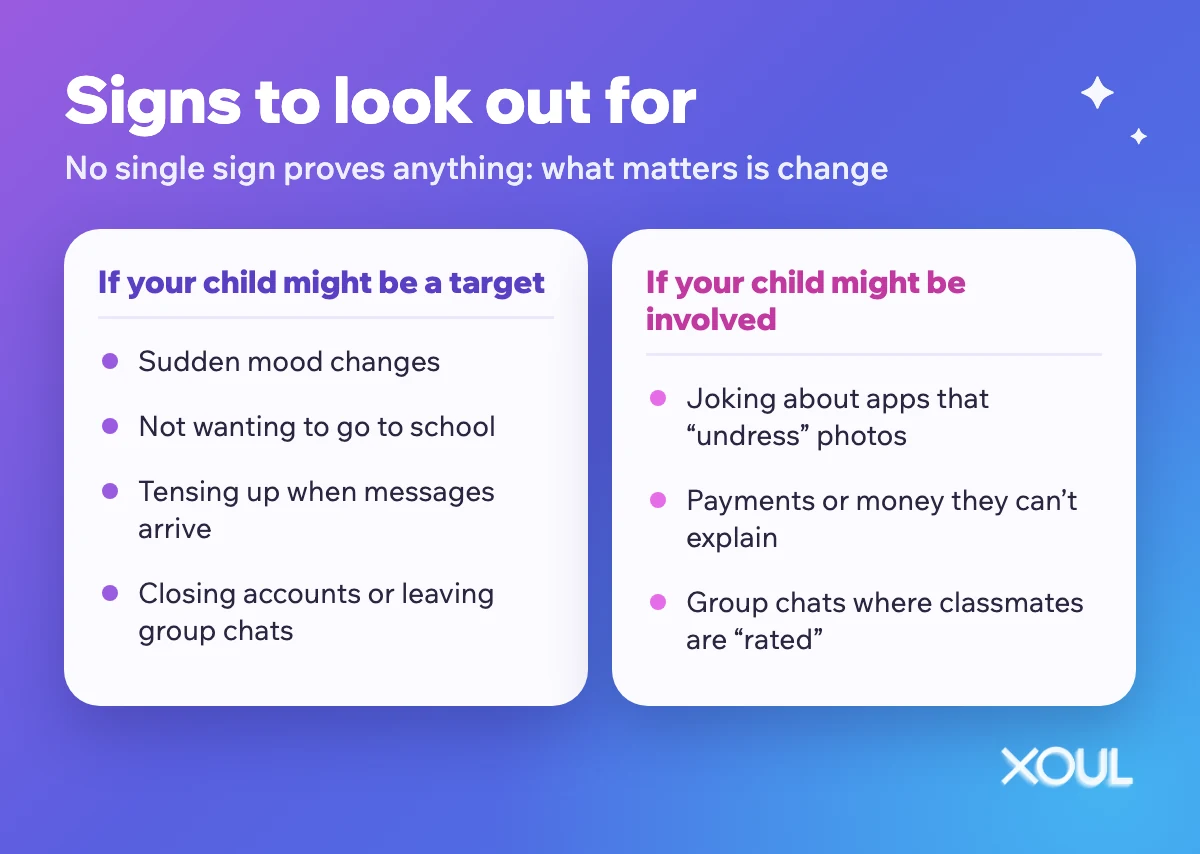
No single sign proves anything. What matters is noticing changes compared with how your child usually is, and opening a conversation without turning it into an interrogation.
Not wanting to go to school or to activities they used to enjoy.
Tensing up when messages arrive, or suddenly avoiding their phone.
Closing or locking down accounts, deleting photos, leaving group chats.
Mentioning jokes, rumours or comments from classmates they won't explain.
Sleeping badly, eating differently or complaining of aches with no clear cause.
If your child might be involved in making or sharing it:
Talking about apps or bots that "undress" photos as if it were funny.
Payments, subscriptions or money they can't explain.
Being part of group chats where classmates' photos are shared or "rated".
Brushing it off with lines like "it's fake, it's not real" or "nobody gets hurt".
For teachers: sudden silences in a group of girls, laughter or looks when a student walks into class, phones being passed around among boys, repeated absences in the same year group.
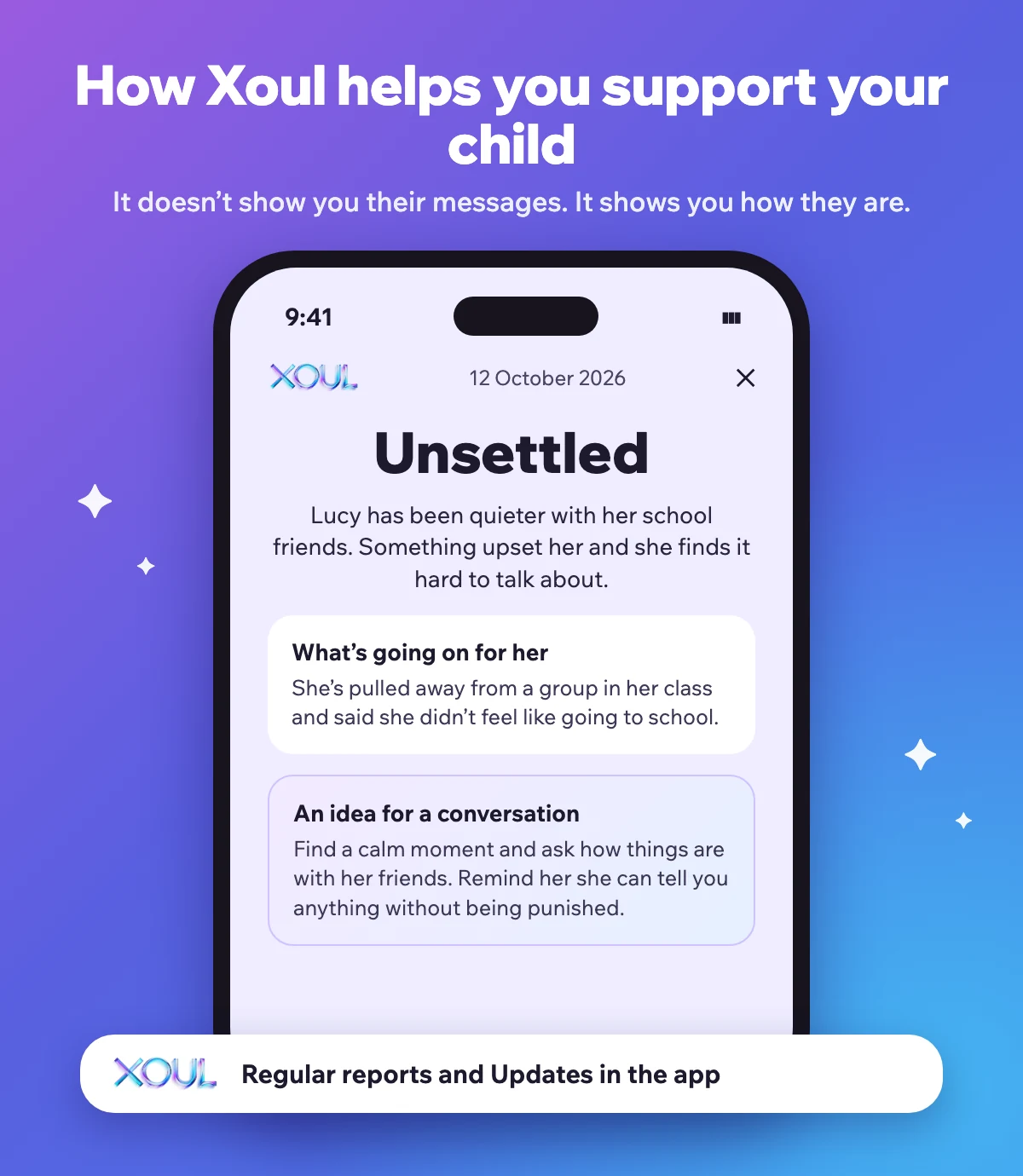
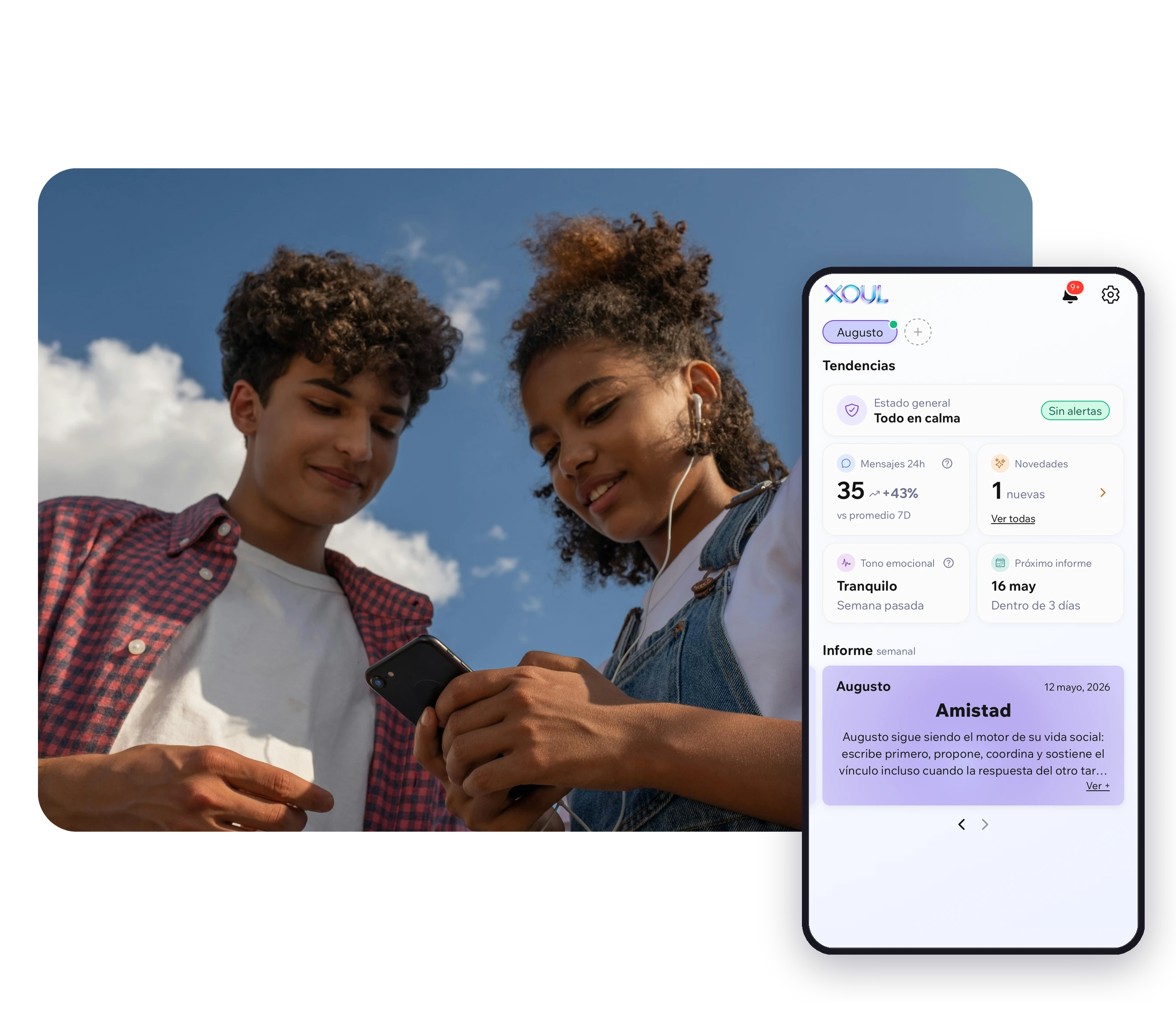
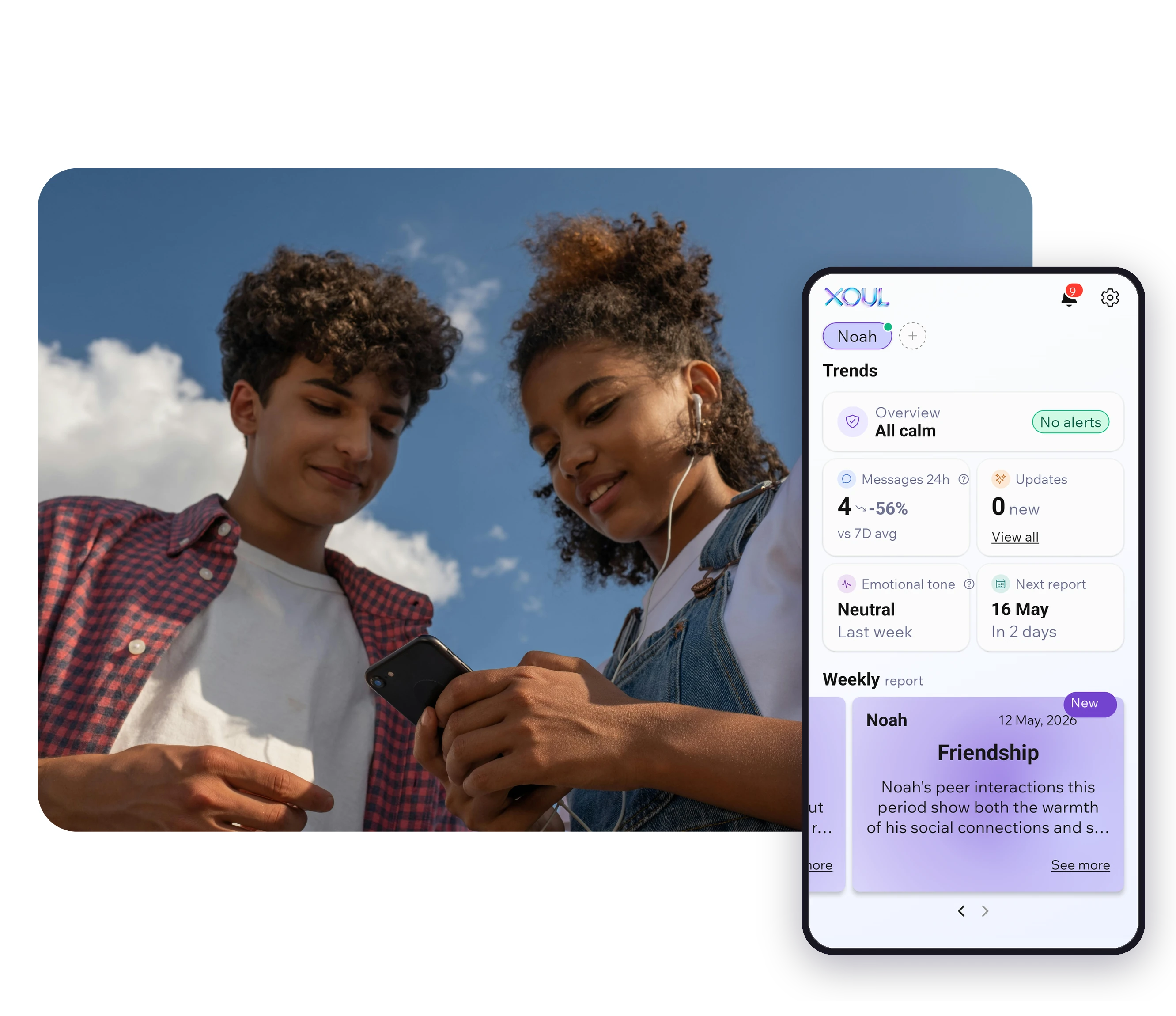
If you use Xoul, changes like these (more silence, pulling away from friends, not wanting to go to school) can show up in the report or in Updates, along with an idea for starting the conversation. Xoul doesn't show you their messages: it shows you how they are.
What to do if your child has been targeted
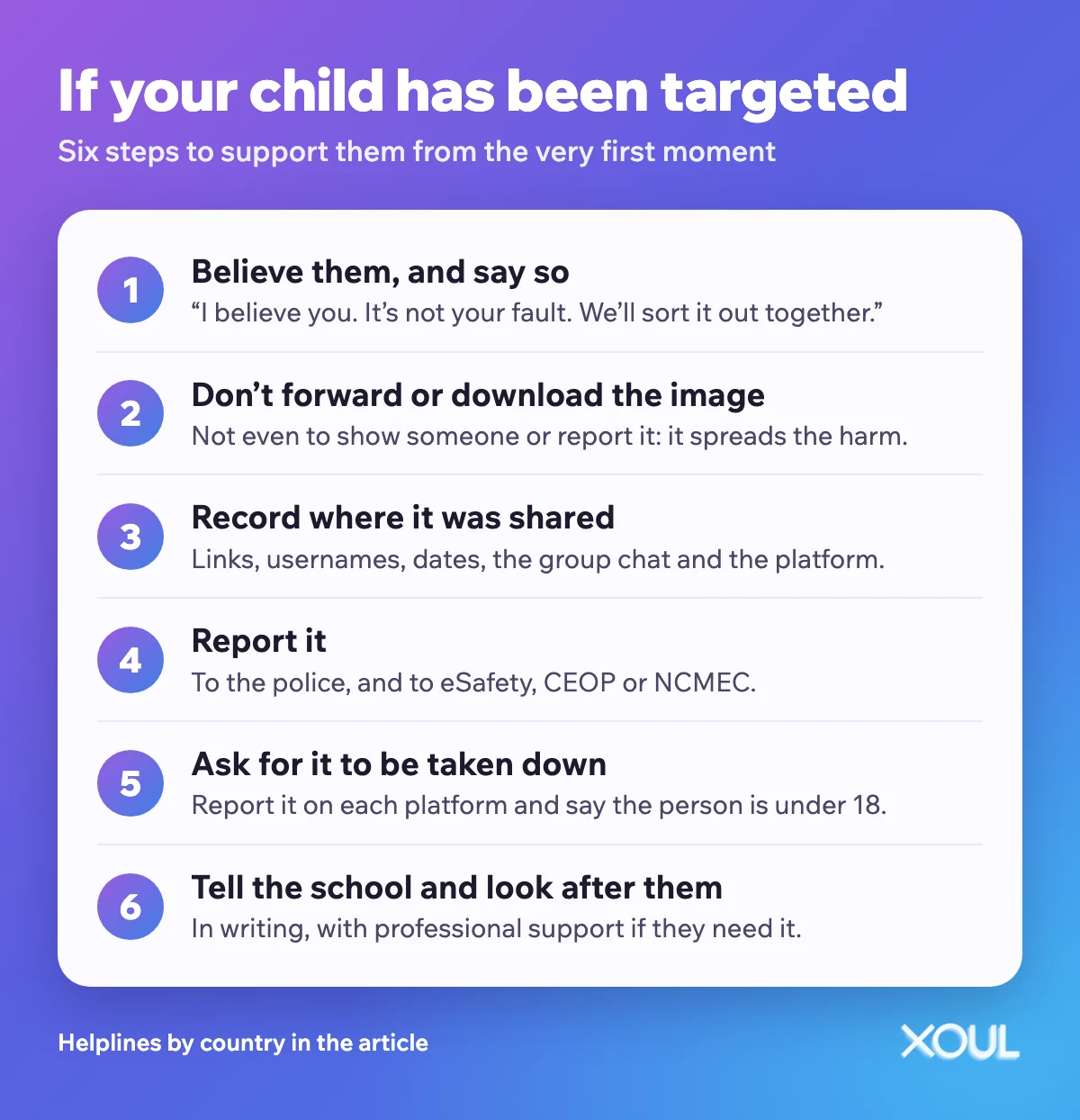
Believe them, and say so. The first words matter: "I believe you. This is not your fault. We'll sort it out together." Posting a photo is not permission for anyone to use it like this.
Don't forward or download the image, not even to show someone or to report it. When the person in it is under 18, keeping or sharing it can itself be a crime, and it spreads the harm.
Record where it was shared, not the image itself: links, usernames, dates, the platform, the name of the group chat, and screenshots of messages that show who shared it. Save these before blocking or confronting anyone, because they can disappear.
Report it. Contact the police: in Australia and the UK, sexual images of under-18s are a police matter; in the US, also report to the NCMEC CyberTipline. All the channels are listed below.
Ask for it to be taken down. Use each platform's reporting tools and say the person is under 18. In Australia, report to eSafety, which can require removal. In the UK, Report Remove helps under-18s get images taken down. In the US, the Take It Down tool and the Take It Down Act's 48-hour rule can help.
Tell the school in writing and ask them to follow their safeguarding procedures. You have a right to know what they are doing to protect your child.
Look after their wellbeing. Get professional support if they need it, and agree together who to tell and who not to. Avoid discussing the case in parent group chats or on social media: even when it's to defend them, it puts them back in the spotlight. In the weeks that follow, Xoul's report helps you see how their mood is going without having to ask every day.
Involve them in decisions. Depending on their age, ask what they need. Getting back some sense of control is part of recovering.
What to do if your child made it, asked for it or shared it
This is one of the hardest things a parent can hear. Supporting your child doesn't mean excusing what happened, and it doesn't mean giving up on them either.
Stay calm and listen first. Ask what happened, with whom and since when, without shouting. You need the full picture.
Don't play it down. "It was a joke" or "everyone was doing it" doesn't change what it is: sexual abuse of a real person. Say so clearly, without humiliating them.
Stop it spreading. They shouldn't send it again, should leave any group chats where it's being shared and shouldn't discuss it. If police or the school are already involved, get legal advice before deleting anything or touching devices.
Cooperate with the school and, if needed, the police. Taking responsibility is usually better for everyone, including your child.
Think about making amends. An apology isn't enough, and a meeting with the person targeted should never be forced. But your child can acknowledge the harm, accept the consequences and help make sure the material disappears.
Get professional help. Understanding why they did it (peer pressure, wanting approval, attitudes towards girls and women, money) is key to making sure it doesn't happen again.
If your child received it: they shouldn't forward it, comment on it or keep it, and they should tell a trusted adult. If they can, they might let the person targeted know they're not alone. Those who receive it and say nothing are part of the chain; those who break it make a difference.
For teachers and school leaders
Don't ask the student who was targeted to keep quiet or to "not make it bigger than it is". In several cases, families have said schools tried to hush things up.
Don't ask to see the image or pass it between staff. It's enough to record where and how it was shared.
Avoid making the student repeat their story to lots of different people.
Follow your safeguarding procedures, inform the families involved and contact police when appropriate. In Australia, eSafety's Toolkit for Schools includes a step-by-step guide for responding to deepfake incidents (eSafety).
Address it with the whole year group, not only with those involved: consent, respect, what to do when something like this lands in your phone. Whole-class conversations help prevent the next case.
How to talk about it at home (before it happens)
You don't need to wait for something to happen. A few ideas to get started:
Use a news story as a way in: "I read that some students at a school made fake photos of their classmates with an app. Have you heard of anything like that?" Asking what they know often opens more doors than a lecture.
Talk about consent online: a photo being on the internet doesn't mean it can be used for anything.
Make it clear that it's abuse, even if it's fake. In Thorn's survey, 1 in 5 young people believed it is legal to create fake nudes of someone else (Thorn).
Offer a safe place: "If this ever happens to you or someone you know, you can tell me. I won't take your phone away or punish you for it." Fear of losing their phone is one of the reasons young people stay silent.
Talk to daughters and sons. To girls, so they know it's not their fault and that they can ask for help. To boys, so they understand the harm, don't take part and push back on the group.
Don't make it about banning photos. Saying "just don't post photos" shifts the blame onto the person who is harmed. The responsibility lies with whoever makes and shares the image.
If you use Xoul, the conversation idea in each report can be a good way to start.
Where to get help and report
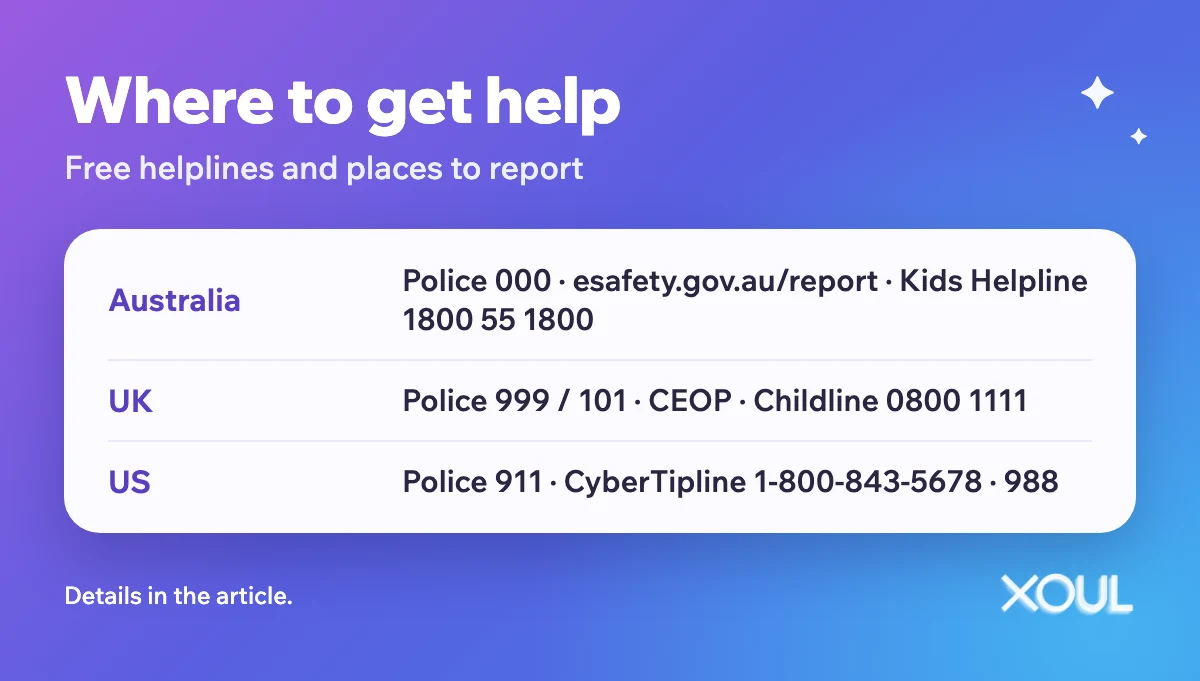
Australia
Police: 000 in an emergency; otherwise contact your local police station.
eSafety Commissioner: report image-based abuse and ask for removal at esafety.gov.au/report. eSafety recommends reporting anything criminal to police first.
Kids Helpline: 1800 55 1800, free, 24/7, for ages 5 to 25 (kidshelpline.com.au).
UK
Police: 999 in an emergency, 101 otherwise.
CEOP (National Crime Agency): report online sexual abuse of under-18s at ceop.police.uk. Young people, parents and professionals can report.
Report Remove (Childline and IWF): helps under-18s confidentially report sexual images of themselves and get them removed (iwf.org.uk).
Childline: 0800 1111, free.
US
Police: 911 in an emergency.
NCMEC CyberTipline:CyberTipline.org or 1-800-843-5678, 24 hours.
Take It Down (NCMEC): helps remove nude or sexual images of under-18s from participating platforms, without the image leaving your device (takeitdown.ncmec.org). NCMEC says it can help "whether real or GAI-created" (NCMEC).
988 Suicide & Crisis Lifeline: call or text 988, 24/7.
Frequently asked questions
Is it illegal if the image is fake?
When the person shown is under 18, yes: in Australia, the UK and the US, sexual images of children made or altered with AI are treated as child sexual abuse material. For adults, newer laws in all three countries cover sharing, and in the UK also creating, fake intimate images.
My daughter had posted the photo on social media. Is she partly to blame?
No. Posting a photo is not permission for anyone to manipulate it. The responsibility lies with whoever alters it and whoever shares it.
What should my child do if they receive an image like this?
Not forward it or keep it, leave the group chat if it keeps being shared, and tell you. If they know the person in it, they can let them or their family know, carefully, and tell the school.
Is it worth asking the platform to take it down?
Yes. In Australia eSafety can require removal; in the US the Take It Down Act requires platforms to act within 48 hours; and Take It Down and Report Remove help under-18s get images removed. First save where the image appeared (not the image itself) so you can report it.
Supporting, not spying
Sexual deepfakes show something we already knew: what happens on the phone also happens at school, in the body and in our children's mood. Banning things isn't enough, and spying breaks the trust we need for them to come to us. What protects them most is a relationship in which they can say "something happened to me" without fear.
How Xoul can help
With your child's consent, Xoul analyses their WhatsApp activity and sends you reports on how they're doing emotionally and on possible risks, without showing you their conversations. If signs of distress, conflict with classmates or situations of exposure come up, you'll see them in the report or in Updates, along with ideas for starting the conversation. Xoul doesn't replace talking at home: it helps you know when it's a good moment to have that talk.
Your first report is free and arrives in 10 minutes.